
Stage Briefing
Your team has now determined that you can use the robot to successfully identify and deliver contaminated water to the treatment area to be purified by reverse osmosis. Next, you will need to ensure the clean water can be identified and transported to the purification area. In this area, UV light will be used to disinfect the water, eliminating harmful disease causing pathogens. UV light damages the cells of microorganisms, like bacteria, so they cannot function or reproduce.
In this stage, your team will need to code the robot to identify clean water and transport it to the purification area, in addition to transporting the contaminated water to the treatment area. Your success in this challenge depends on how well you can use the data from the AI Vision Sensor to make decisions in a VEXcode project.
You will solve the challenge using the three-phase process of Planning, Pseudocoding, and Building and Testing, checking in with your teacher after each phase. Your team will be evaluated using the Clean Water Mission Rubric. You can revisit the Clean Water Mission Unit Overview at any time to review the process or rubric information.
Challenge Details
Setup
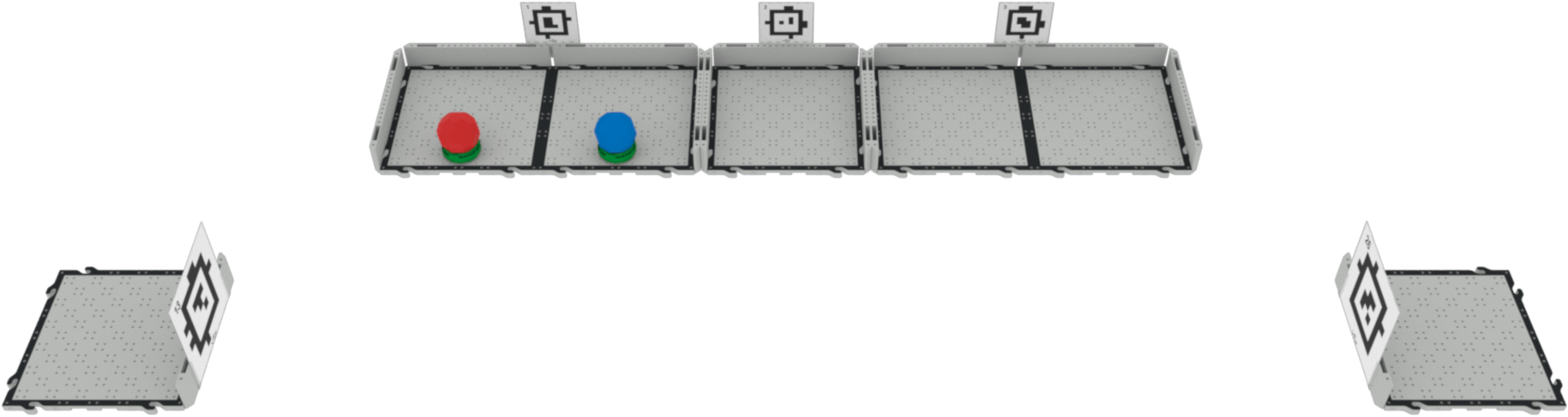
The Sort and Sanitize Challenge uses the collection, treatment, and purification areas, as shown here. Two Tiles with walls are added to the right of the collection and treatment areas from Stage 1, to create the purification area. Each area is identified by an AprilTag. Additionally, two AprilTags are also used to identify the left and right boundary of the water treatment system.
Buckyballs are used to represent the water. The red Buckyball represents contaminated water, and the blue Buckyball represents clean water. Each Buckyball sits on a green Ring in the collection area, to keep it in place during the challenge.
Challenge Document
The Challenge Document details the key information and criteria for solving the Sort and Sanitize Challenge. It is important to read the Challenge Document together with your team to be sure you understand the setup and requirements for completing the challenge. You can use this resource to help you document the challenge in your engineering notebook as well.
The goal of the Sort and Sanitize Challenge is to identify both contaminated and clean water in the collection area, then deliver the clean water to the purification area and the contaminated water to the treatment area twice.
Read the Challenge Document to learn about the details of the Sort and Sanitize Challenge.
By the end of the Sort and Sanitize Challenge, both contaminated and clean water will be identified and delivered to the appropriate area in the water treatment system. Once water is delivered by the robot, it can be removed by hand and placed behind the wall of that area, as shown below. You can return to the Clean Water Mission Unit Overview at any time for additional resources to help you as you work through this Stage.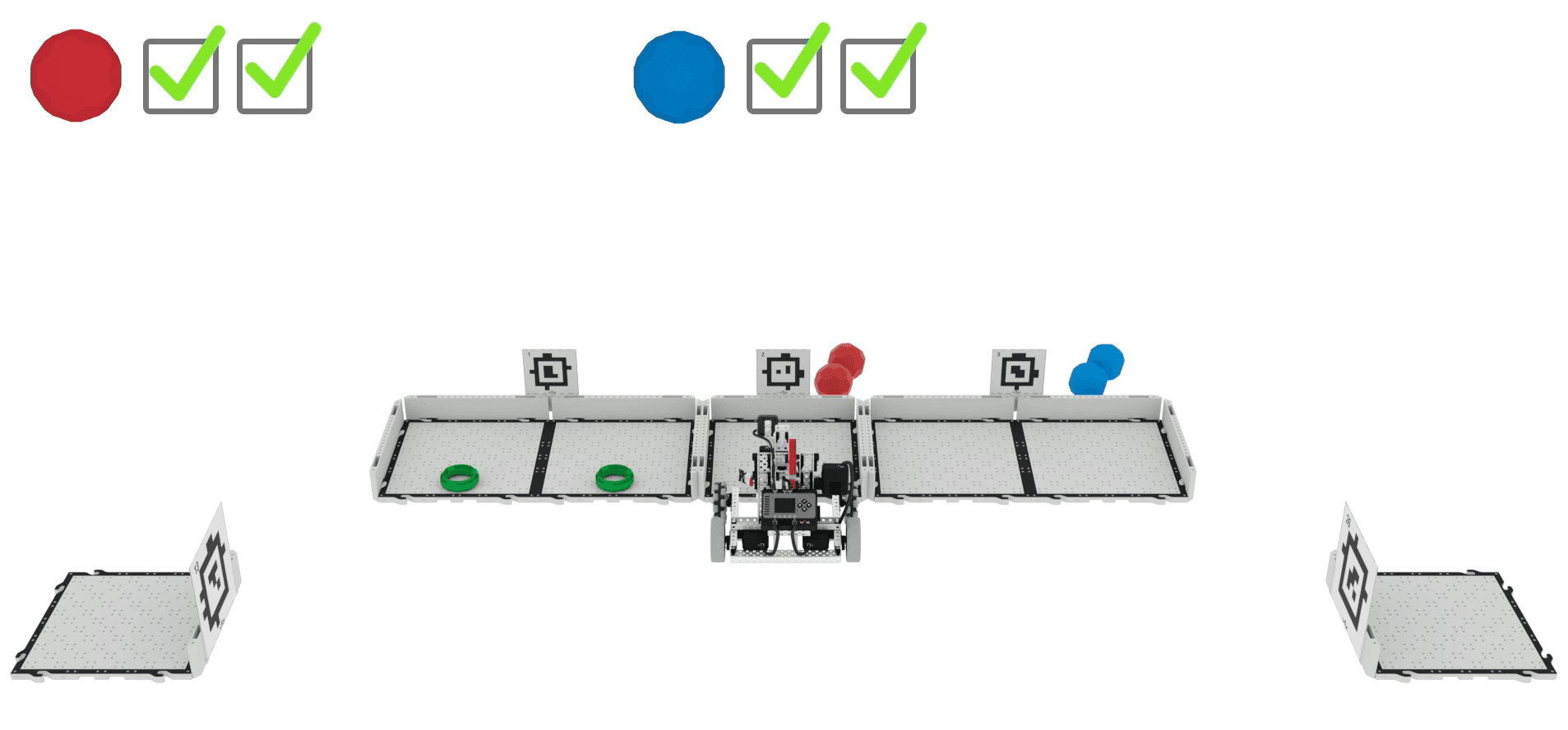
Final Review
Once your team has completed the challenge, meet with your teacher to review your progress throughout all of the phases of the challenge. You will complete the rubric together. It will evaluate your team’s planning, pseudocode, coding project, collaboration, and usage of the AI Vision Sensor.
Clean Water Mission Open-Ended Challenge Rubric
Wrap Up Reflection
Once you have completed the Sort and Sanitize Challenge, it is time to reflect on your process and progress. First, answer the questions below in your engineering notebook. Then, meet again as a team to share and discuss your answers with one another.
- How accurately did your team complete the challenge? What specific actions or decisions contributed to this outcome? What improvements could you make to your project?
- What data did your team use from the AI Vision Sensor? How did that data impact your team's ability to complete the challenge?
- What role did you play in your team during this challenge? How did your contributions help to reach team goals? How would you improve on your ability to collaborate effectively?
- How could the skills and knowledge you gained from this challenge be applied to future challenges, or to real-world problems?
- What aspect of this challenge did you find most difficult, and what did you learn by working through it?