Before You Begin
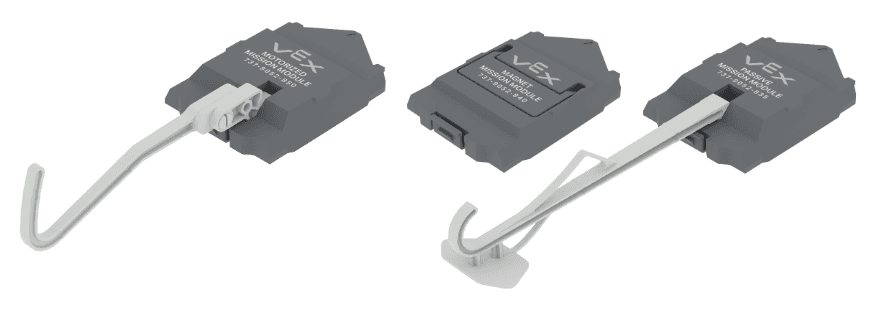
This unit introduces students to the different modules available for the VEX AIR Drone, and explores how modules enable the drone to interact with its indoor environment. Students will explore how the drone needs to move in order to interact with objects and consider how carrying objects affects the drone's flight. Students will also examine the Passive Module and experiment with how to use it in flight.
Learning Objectives:
By the end of the unit, students will be able to:
- Identify the three VEX AIR modules and describe what each is designed to do.
- Identify how modules attach to and detach from the VEX AIR Drone.
- Explain why the drone should always be flown with a module attached.
- Identify the purpose of the Passive Module and describe how it uses gravity to pick up and release objects.
Use this article to help you facilitate students' exploration of modules throughout this unit.
Environment Setup and Materials
Ensure that your indoor flight area is marked and labeled, and that students know the safety procedures for your space. Use the following articles to help you as you set up your space and ready your students for flight.
Students will need access to the contents of their VEX AIR Kit for this unit, including charged batteries. For more information about charging batteries, see this article.
In this unit, students will be both manipulating the drone by hand and flying the drone to move cargo and orbit balls using the Passive Module. Ensure that you have the following for your flight area:
- 1 orbit ball
- 1 piece of cargo
- 2 pickup locations for cargo and orbit balls:
- If you have the VEX AIR Drone Competition Field Kit, use the Long Rack to hold both game objects or a combination of the Short Rack and provided plates to hold the orbit balls and cargo.
- If you have the VEX AIR Classroom Bundle, use the Field Plates. Field Plates can act as pickup locations for both game objects.
- 1 drop-off location for orbit balls:
- If you have the VEX AIR Drone Competition Field Kit, use a Drop Tower Goal or Drop Zone Goal.
- If you do not have that kit, you can use a basket, box, or other receptacle.
- 1 drop-off location for cargo:
- If you have the VEX AIR Drone Competition Field Kit, use a Cargo Platform.
- If you do not have that kit, you can use a hook and loop surface. These could include felt, higher pile carpet, or another hook and loop surface.
Note: Be sure the pickup and drop-off zones are securely weighed down or anchored to the ground so that air turbulence from the propellers (or downwash) from the propellers do not affect the area.
Standards Alignment
Common Core English Language Arts (CCSS ELA)
- CCSS.ELA-LITERACY.CCRA.L.6 - Acquire and use accurately a range of general academic and domain-specific words and phrases sufficient for reading, writing, speaking, and listening at the college and career readiness level; demonstrate independence in gathering vocabulary knowledge when encountering an unknown term important to comprehension or expression.
- CCSS.ELA-LITERACY.RST.9-10/11-12.3 - Follow precisely a complex multistep procedure when carrying out experiments, taking measurements, or performing technical tasks, attending to special cases or exceptions defined in the text.
- CCSS.ELA-LITERACY.RST.9-10/11-12.4 - Determine the meaning of symbols, key terms, and other domain-specific words and phrases as they are used in a specific scientific or technical context relevant to grade level topics.
International Society for Technology in Education (ISTE)
- Empowered Learner – 1.1.c – Students use technology to seek feedback that informs and improves their practice and to demonstrate their learning in a variety of ways.
- Knowledge Constructor – 1.3.d – Students build knowledge by exploring real-world issues and gain experience in applying their learning in authentic settings.
- Global Collaborator - 1.7.c - Students contribute constructively to project teams, assuming various roles and responsibilities to work effectively toward a common goal.