
Using Work Cells in Manufacturing Facilities
Work Cells
Work cells are a critical part of manufacturing facilities. A work cell is a specialized arrangement of people, equipment, tools, and materials in a manufacturing environment used to improve the quality, speed, and cost of the production process. Work cells are designed to complete the manufacturing tasks in sequence. The types of equipment and the sequence are determined by the product being made.
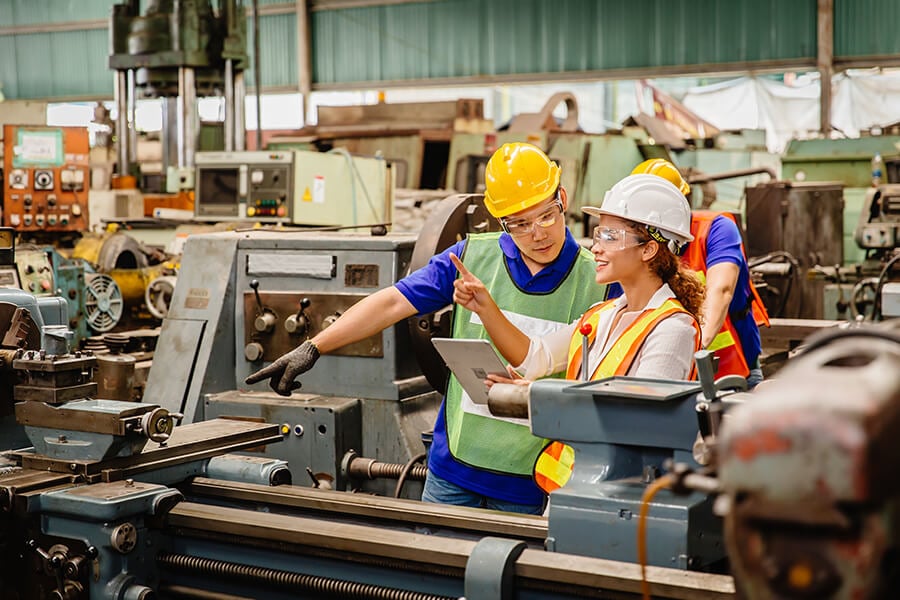
Group technology classifies similar parts or products into part/product families so they can be matched to manufacturing tasks. Group technology is used for identifying components with similar parts and manufacturing requirements in order to streamline workflow.
The layout of a work cell can provide:
- simplified material flow.
- minimal transportation distance.
- promote communication.
- enable a single piece flow.
Work cells can include manual and automated equipment. In the case of manual machines run by a single operator, the cell could have a U-shape. This shape allows the cell operator to start the next part after the previous part has been completed.
Automated cells can include robots and/or other automated equipment. For example, an operator could be working in an automated welding cell with an automated welding machine and a turntable. The work is loaded and unloaded from the turntable by the cell operator. After the automated welding machine welds a part, the turntable moves the next part into position to be welded.
Another example of an automated cell is a robot being used to weld at two different welding stations by employing a robot shuttle. In this case, the system is not fully automatic and requires the operator to call up the correct robot-welding program. Any product changeover needs to be completed manually.
However, with a flexible (manufacturing/welding) system (FMS/FWS) each part arriving on a pallet will be recognized by the supervisory controller of the cell. The asking robot controller will automatically call up the right program. The cell controller also handles loading and unloading sequences.
Work Cell Design and Development

The design process for a work cell can include a number of things such as:
- Logic: using flowcharting or other tools to determine the most efficient behavior for the devices in a work cell to complete a task.
- Robot Trajectory: planning out a robot's behaviors within a work cell including its speed, position, and actions and how they relate to the other devices within the cell.
- I/O Mapping: creating a schematic or chart which indicates each of the input and output connections between the work cells processors (PLC, robot processors, CNC machine processors, etc.) and their devices.
- Cycle time: the elapsed time between a work cell starting an action and the time it takes to complete the action.
- Cost analysis: an accounting of all the costs related to production to create a projected margin of profit.
The work cell design and development process is often completed using Virtual Simulation and OFF-LINE Programming tools. These tools enable engineers to:
- Design a virtual model of the work cell.
- Program the work cell including its input/output schemes.
- Outline trajectory plans.
- Download the programs to the robots after the completion of the design.
These programs can also be used to design the work cell for operator safety, ergonomics and human factors, and help determine cycle times.