
Preview
- Grade(s): 9-12
- Time: 2 weeks
Description
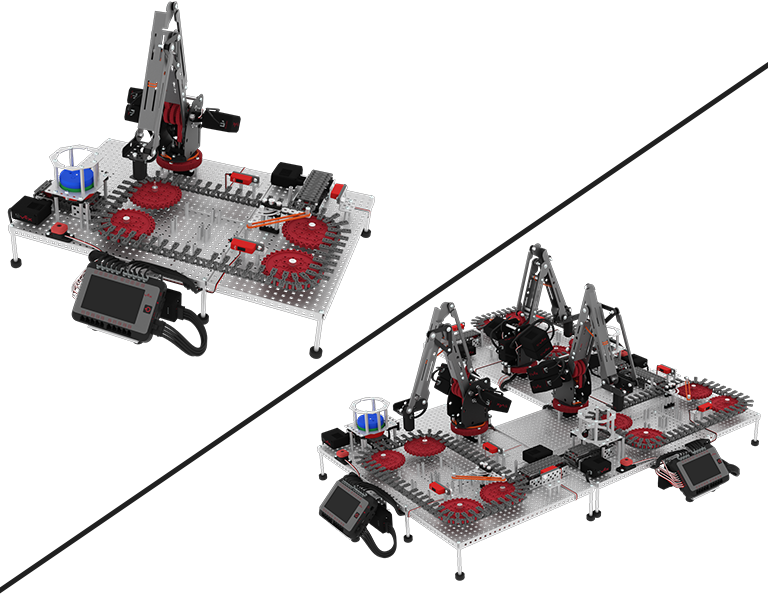
Students will be guided through different troubleshooting techniques, as well as helpful suggestions, for how to prepare the Workcell for competition. After the students have explored these techniques, they will complete a mini-competition. The goal of the mini-competition is to sort as many ‘shipments’ as possible in a 5-minute round. A shipment is a collection of six disks: two red, two green, and two blue. After the students have participated in the mini-competition, they will take a post-survey to inventory their attitudes about robotics, to see how their attitudes have changed throughout the course.
Essential Question(s)
- How do I prepare the Workcell for competition?
- What are the steps to troubleshoot the Workcell?
Understanding(s)
Students will understand:
- How to adjust the hardware on the Workcell to troubleshoot and improve the performance.
- How to adjust a VEXcode V5 project to improve the functionality of the Workcell.
- How to engage in an iterative design process.
Objective(s)
- Identify how to ensure the mastering values for the Workcell are passing.
- Identify how to adjust the the parameters of the blocks in a VEXcode V5 project.
- Identify how to use the Jogging example project in VEXcode V5.
- Identify how to use [Comment] blocks in a project.
- Identify how to lubricate the Workcell's turntable.
- Identify how to adjust the low and high threshold values of Line Trackers in a VEXcode V5 project.
- Identify how to use [Print] blocks in a VEXcode V5 project.
- Identify how to adjust the metal on the Workcell to add additional motors, sensors, or diverters.
- Identify that engaging in an iterative design process involves decomposing an outcome into individual behaviors.
Vocabulary
- Troubleshooting
- the process of identifying why something does not work effectively and making suggestions on how to improve it.
- Iteration
- the process of repetition in order to refine and improve a procedure to reach a desired outcome.
Materials Needed
Educational Standard(s)
- Next Generation Science Standards: HS-ETS1-3. Evaluate a solution to a complex real-world problem, based on prioritized criteria and trade-offs that account for a range of constraints, including cost, safety, reliability, and aesthetics, as well as possible social, cultural, and environmental impacts.
- Computer Science Teacher Association: 3A-AP-18 Create artifacts by using procedures within a program, combinations of data and procedures, or independent but interrelated programs.
- Computer Science Teacher Association: CSTA 3A-AP-13 Create prototypes that use algorithms to solve computational problems by leveraging prior student knowledge and personal interests.
- Computer Science Teacher Association: 3A-AP-17 Decompose problems into smaller components through systematic analysis, using constructs such as procedures, modules, and/or objects.
Go to this page in the Knowledge Base to see a cumulative list of VEX V5 Workcell STEM Labs standards.