
Preview
- Grade(s): 9-12
- Time: 1.5 weeks
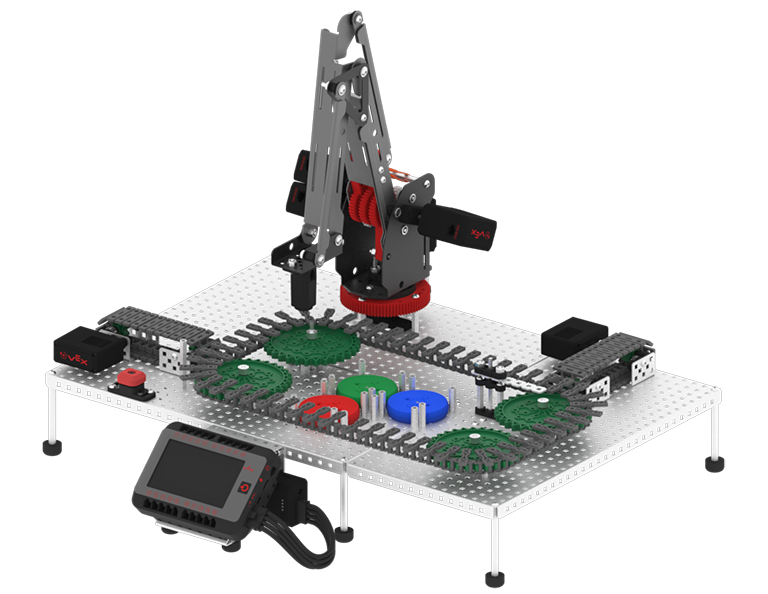
Description
- Students will build a project to move two disks (red and green) through a conveyor system. In their project, students will program a red disk to be diverted off the conveyor system, and program a green disk to travel through the system and stop in front of the arm mounted on the VEX V5 Workcell.
- Students will be introduced to using blocks from the ‘Motion’ category in VEXcode V5 in their project to control the diverter and different conveyors with their associated motors.
- Students will also be reading about material handling systems and manufacturing system types.
Essential Question(s)
- What is a conveyor and how it is used to move objects?
Understanding(s)
Students will understand:
- Ways that conveyors are used in industrial situations.
- Why it is important to have devices which can move objects on and off conveyors.
- Why it is important for conveyors to have sensors.
Objective(s)
- Follow a set of build instructions to assemble the conveyor.
- Describe what a conveyor is and how it is used to move objects.
- Discuss why a conveyor does not perform well without the use of diverters.
Vocabulary
- Conveyors
- A type of system which can consist of belts, rollers, chains, moving mesh, or other components which moves materials from one place to another.
- Diverter
- A device to move an object “on to” or “off of” a conveyor system.
- Indexing tables
- Controls the order in which objects are placed on a conveyor system.
- Jigs/fixtures
- A jig is a tool that guides a machining tool and a fixture is a tool which secures an object on a machine bed at a specified location.
- Mass production
- The manufacturing of large numbers of standardized products.
- Small batch
- The manufacturing of small numbers of products, usually limited to less than 500 items.
- Job shops
- Small manufacturing systems which make custom or semi-custom products.
Materials Needed
| Quantity | Materials Needed |
|---|---|
| 1 |
VEX V5 Workcell |
| 1 |
Build Instructions |
| 1 |
VEXcode V5 |
| 1 |
Engineering Notebook |
| 1 |
Device to run VEXcode V5 |
| 1 |
Micro-USB cable |
| 2 |
Colored Disks (1x red, 1x green) |
Educational Standard(s)
- Next Generation Science Standards (NGSS) HS-ETS1-2: Design a solution to a complex real-world problem by breaking it down into smaller, more manageable problems that can be solved through engineering.
- Next Generation Science Standards (NGSS) HS-ETS1-4: Models (e.g., physical, mathematical, computer models) can be used to simulate systems and interactions—including energy, matter, and information flows—within and between systems at different scales.
- Computer Science Teacher Association (CSTA) CSTA 3A-AP-18: Create artifacts by using procedures within a program, combinations of data and procedures, or independent but interrelated programs.
- Computer Science Teacher Association (CSTA) CSTA 3A-AP-13: Create prototypes that use algorithms to solve computational problems by leveraging prior student knowledge and personal interests.
Go to this page in the Knowledge Base to see a cumulative list of VEX V5 Workcell STEM Labs standards.