
Preview
- Grade(s): 9-12
- Time: 0.5 week
Description
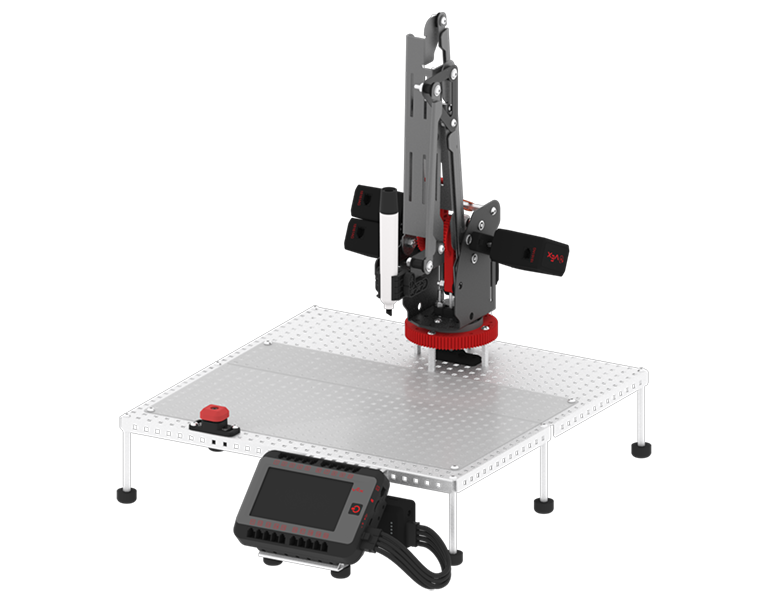
After successfully creating a project in VEXcode V5 to move the arm mounted on the VEX V5 Workcell, it is time to examine things closer and relate them to the industrial robots used in manufacturing. In this Lab, students will explore the following topics: a manufacturing robot’s controller, operating systems, motion control, and robot dynamics.
Essential Question(s)
- How can a user program be used to control an industrial robot within three-dimensional space?
Understanding(s)
Students will understand:
- How the V5 Workcell relates to the different industrial robot controllers/operating systems including elements of the controller.
- How robot dynamics affect the programming of a robot.
- What are the types of motions a manipulator can make and why this is important in manufacturing.
- Identify two different point-to-point motion types including linear and joint.
- How linear movement is more precise, and joint movement is faster.
Objective(s)
- Open, download, and run a project on the V5 Brain.
- Compare joint movement and linear movement and the benefits of each.
- Describe how robot dynamics focuses on the forces acting on a robot that impact its movement.
- Describe different industrial robot controllers/operating systems including elements of the controller.
Vocabulary
- Frame
- A fixed or moving Cartesian coordinate system placed at the critical parts of the manipulator.
- World/Base Frame
- A fixed (non-moving) Cartesian coordinate system located at the base of the robot. It is used in determining the x, y, z coordinates of the robot’s wrist. Jog Frame may replace this frame if an industrial robot is not fixed to the ground, i.e. on a cart with wheels. Jog Frames are parallel to the base of a fixed robot.
- Joint Frame
- These movable (translating and rotating) Cartesian coordinate systems are placed at each joint of the manipulator.
- Joint Motion
- The robot’s Tool-Center-Point follows the shortest possible arc between two known points.
- Linear Motion
- The robot’s Tool-Center-Point follows a straight line between two known points.
- Operating system
- A lower level set of software which allows the user program to communicate with the robotic hardware.
- Programming device
- Hardware which uses the programming software. This can be a computer or mobile device. In industrial robotics a common device used is a Human Pendant (teach pendant).
- Download
- The process of transferring the user program to the robot’s controller.
- Programming software
- Software package which allows for the creation of a custom user program to control the robotic system. The Programming language used for many industrial robots is known as Ladder Logic.
- Robot dynamics
- The relationship between all of the forces acting on the robot and its motion.
- User program
- A custom program written to control the robotic system.
Materials Needed
| Quantity | Materials Needed |
|---|---|
| 1 |
VEX V5 Workcell |
| 1 |
Build Instructions |
| 1 |
VEXcode V5 |
| 1 |
Engineering Notebook |
| 1 |
Device to run VEXcode V5 |
| 1 |
Micro-USB cable |
| 2 |
Dry-erase markers (two different colors) |
Educational Standard(s)
- Next Generation Science Standards (NGSS) HS-ETS1-2: Design a solution to a complex real-world problem by breaking it down into smaller, more manageable problems that can be solved through engineering.
- International Society for Technology in Education (ISTE) 5c: Students break problems into component parts, extract key information, and develop descriptive models to understand complex systems or facilitate problem-solving.
- Common Core State Standards CCSS.ELA-LITERACY.W.11-12.2: Write informative/explanatory texts to examine and convey complex ideas, concepts, and information clearly and accurately through the effective selection, organization, and analysis of content.
Go to this page in the Knowledge Base to see a cumulative list of VEX V5 Workcell STEM Labs standards.