
Preview
- Grade(s): 9-12
- Time: 0.5 week
Description
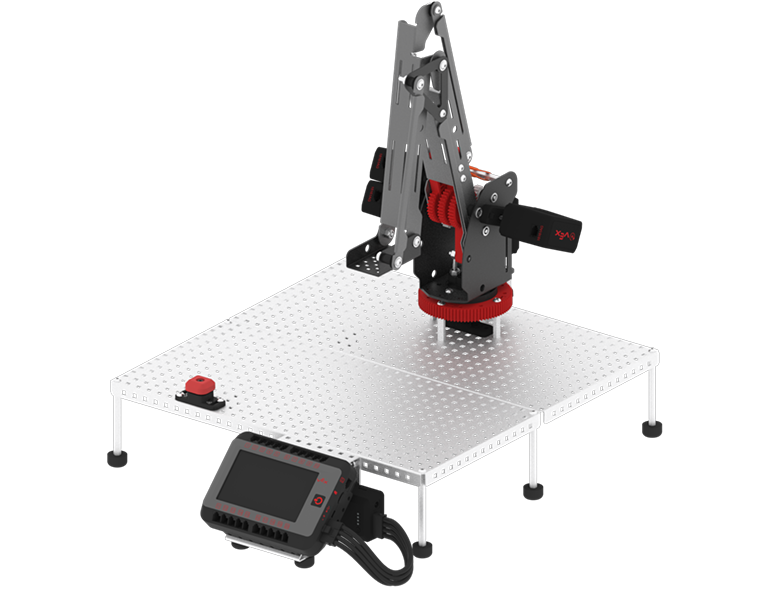
Students will use the VEX V5 Workcell build with a Bumper Switch to explore the question “What safety mechanisms and precautions are taken when working with Industrial Robots?” Students will add the Bumper Switch to their Workcell, and program it to function as an Emergency Stop (E-stop). They will learn about regulatory agencies, common safety mechanisms, and workplace safety precautions that help keep workers safe when working alongside robots. Then, they will look for pinch points on their own arm mounted on the V5 Workcell, and discuss safety precautions in real-world applications.
Essential Question(s)
- What are safety mechanisms and safety precautions, and how do they protect workers within the field of Industrial Robotics?
- What types of special safety issues need to be considered when working with Cobots?
Understanding(s)
Students will understand:
- Why are safety mechanisms, precautions, and standards important for Industrial Robotics?
Objective(s)
- Follow building instructions to attach a Bumper Switch to the V5 Workcell.
- Program the Bumper Switch to act as an E-stop button using VEXcode V5.
- List safety mechanisms, including e-stops and pressure mats, and safety precautions necessary to operate Industrial Robots safely.
- Identify Industrial Robotic safety standards listed by the RIA and OSHA.
- Recognize pinch points on the arm mounted on the V5 Workcell.
- Describe what collaborative robots (Cobots) are and special considerations needed to work safely with them.
Vocabulary
- Emergency Stop Button (E-Stop)
- A large well-placed red button that will completely stop its assigned equipment or electrical circuit. Once the button has been pushed it is locked in the off position and will need to be reset before the equipment or the motor circuit can be turned back on.
- Light Curtain
- These are an array of electronic eyes and light beams that are assigned to a piece of equipment. The equipment will automatically turn off if something blocks one or more of the light beams.
- Collision Detection Sensors
- There are a number of different types of electronic sensors used for collision detection. The purpose of these sensors is to automatically stop a piece of equipment from moving just before or upon contact with a person or foreign object.
- Pressure Mat
- A mat on the floor just outside the workspace in which the equipment moves. If someone steps on the mat its sensors will automatically turn off or slow down the equipment.
- Interlocked Barrier Guard
- A barrier like a fence that surrounds the workspace in which the equipment moves. If the gate to the barrier is opened its sensors will automatically turn off or slow down the equipment.
- Dead Man Switch
- A switch on the teach pendant. The programmer holding the teach pendant needs to squeeze this switch. Releasing the switch removes power from the motor.
- Personal Protection Equipment (PPE)
- There are many different types of protective equipment for people to wear in manufacturing. Some of the categories are head protection, face and eye protection, body protection, fall protection, and respiratory protection.
- Safety Alerts
- There are many different types of safety alerts. Some common types are warning and precaution signs, warning lights, warning sounds, and alarms, and pre-recorded spoken warning messages.
- Barriers
- These are structures to separate the equipment’s workspace and people. These can be as advanced as see-through airtight walls to as simple as a chain barrier to define the workspace.
- Tagout/Lockout
- Whenever equipment setup, maintenance, or repairs are being done, in most cases the power is turned off. When this happens a tag can be placed on the power switch indicating work is being done and do not turn the equipment on. This is known as tagout. A more secure system uses a keylock to physically lock the power switch off. This is known as lockout and requires a key or a code to turn the equipment back on.
- Pinch Points
- Occur whenever a moving object comes in contact with another object. This could be an arm with a platform, two gears intermeshing, two sections of an arm, or any number of things involved with robotics.
- Collaborative Robot (Cobot)
- These are robots that are designed to work collaboratively with people. Extra safety features need to be used on these robots to make sure people can safely enter the robot’s workspace.
- RIA (Robotic Industry Association)
- The association that sets safety standards for Industrial Robots.
- ANSI (American National Standards Institute)
- An institute that maintains standards for workplace safety in the United States.
- ISO (International Organization for Standardization)
- An organization that maintains international standards for workplace safety.
- OSHA (Occupational Safety and Health Association)
- The federal administration that sets and enforces workplace safety regulations.
Materials Needed
| Quantity | Materials Needed |
|---|---|
| 1 |
VEX V5 Workcell |
| 1 |
Build Instructions |
| 1 |
VEXcode V5 |
| 1 |
Engineering Notebook |
| 1 |
Device to run VEXcode V5 |
| 1 |
Micro-USB cable |
| 1 |
Lab 2 Building Materials (see build instructions) |
Educational Standard(s)
- Next Generation Science Standards (NGSS) HS-ETS1-3: Evaluate a solution to a complex real-world problem based on prioritized criteria and trade-offs that account for a range of constraints, including cost, safety, reliability, and aesthetics as well as possible social, cultural, and environmental impacts.
- International Society for Technology in Education (ISTE) 5c: Students break problems into component parts, extract key information, and develop descriptive models to understand complex systems or facilitate problem-solving.
- Common Core State Standards CCSS.ELA-LITERACY.W.11-12.2: Write informative/explanatory texts to examine and convey complex ideas, concepts, and information clearly and accurately through the effective selection, organization, and analysis of content.
Go to this page in the Knowledge Base to see a cumulative list of VEX V5 Workcell STEM Labs standards.