
Preview
- Grade(s): 9-12
- Time: 1 week
Description
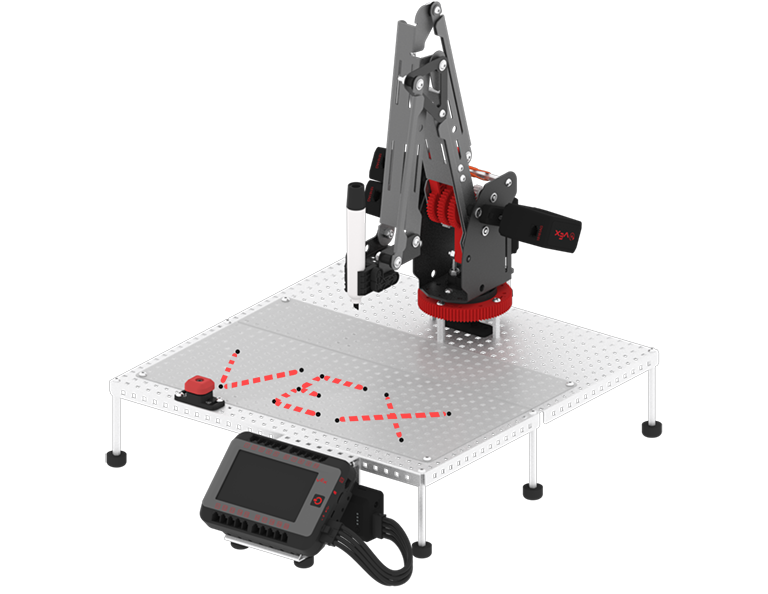
In the following activity, students will explore how to store (x, y, z) coordinates in a 2D List in order to draw two triangles using a dry-erase marker. Then, students will be reading about the relationship and value of accuracy and repeatability with industrial robots. Finally, students will instruct the arm mounted on the VEX V5 Workcell to draw ‘VEX’ on the whiteboard.
Essential Question(s)
- What are some programming concepts which can be used to store locations in order for a robot to move in different motions?
Understanding(s)
Students will understand:
- What are 2D Lists and how are they used in programming a robot?
Objective(s)
- Apply 2D Lists in order to have the V5 Workcell create a drawing.
Vocabulary
- Array
- A type of programming structure that allows a group of values to be stored.
- Registers
- Array-based elements that store data to be used/manipulated in the robot program.
- List
- A block in VEXcode V5 which allows the storage of multiple values in one row.
- End of Arm Tooling (EOAT)/End-Effector
- End-Of-Arm-Tooling or an end-effector is the term used for robotic tooling for manipulating parts mounted on the end of the robot arm. Examples are grippers, magnets, welders, paint guns, etc.
- Non-servo Robots
- Robots (mainly pneumatic) that have only 2 positions, one at each limit of motion.
- Servo Robots
- They are hydraulically or electrically driven robots with the ability to stop at any point along the path between the two-programmed (known) points.
Materials Needed
| Quantity | Materials Needed |
|---|---|
| 1 |
VEX V5 Workcell |
| 1 |
Build Instructions |
| 1 |
VEXcode V5 |
| 1 |
Engineering Notebook |
| 1 |
Device to run VEXcode V5 |
| 2 |
Dry-Erase Marker (multiple colors) |
Educational Standard(s)
- Next Generation Science Standards (NGSS) HS-ETS1-2: Design a solution to a complex real-world problem by breaking it down into smaller, more manageable problems that can be solved through engineering.
- International Society for Technology in Education (ISTE) 6b: Students create original works or responsibly repurpose or remix digital resources into new creations.
- Computer Science Teaching Association (CSTA) 3A-AP-14: Use lists to simplify solutions, generalizing computational problems instead of repeatedly using simple variables.
Go to this page in the Knowledge Base to see a cumulative list of VEX V5 Workcell STEM Labs standards.