Before You Begin
Before You Begin
In this unit, students will explore the three movement modes available for the VEX AIR Drone: Precision, Balanced, and Performance. Each mode provides distinct levels of responsiveness and stability during flight. Students will learn to evaluate mission requirements and select the movement mode best suited for specific tasks.
Be sure students have the following ready for use before you begin:
- A charged VEX AIR Drone Controller
- A USB-C cable
- A computing device with access to VEXcode AIR
Learning Objectives:
- Identify the three movement modes (Precision, Balanced, Performance) and their appropriate flight applications.
- Explain how each movement mode affects the drone's responsiveness and stability during flight.
- Demonstrate controlled flight using Precision, Balanced, and Performance modes in the simulator.
- Evaluate flight task requirements and select the most appropriate movement mode.
- Describe how flight algorithms adjust drone behavior (speed limits, responsiveness, stability assist) when switching between modes.
Standards Alignment
The following standards can be reached in this unit. To learn how these standards are met, and view a comprehensive standards alignment, go to standards.vex.com.
Common Core English Language Arts (CCSS ELA)
- CCSS.ELA-LITERACY.CCRA.L.6 - Acquire and use accurately a range of general academic and domain-specific words and phrases sufficient for reading, writing, speaking, and listening at the college and career readiness level; demonstrate independence in gathering vocabulary knowledge when encountering an unknown term important to comprehension or expression.
- CCSS.ELA-LITERACY.RST.9-10/11-12.3 - Follow precisely a complex multistep procedure when carrying out experiments, taking measurements, or performing technical tasks, attending to special cases or exceptions defined in the text.
- CCSS.ELA-LITERACY.RST.9-10/11-12.4 - Determine the meaning of symbols, key terms, and other domain-specific words and phrases as they are used in a specific scientific or technical context relevant to grade level topics.
International Society for Technology in Education (ISTE)
- Empowered Learner - 1.1.c - Students use technology to seek feedback that informs and improves their practice and to demonstrate their learning in a variety of ways.
- Empowered Learner – 1.1.d – Students understand fundamental concepts of how technology works, demonstrate the ability to choose and use current technologies effectively, and are adept at thoughtfully exploring emerging technologies.
- Knowledge Constructor – 1.3.d – Students build knowledge by exploring real-world issues and gain experience in applying their learning in authentic settings.
- Global Collaborator - 1.7.c - Students contribute constructively to project teams, assuming various roles and responsibilities to work effectively toward a common goal.
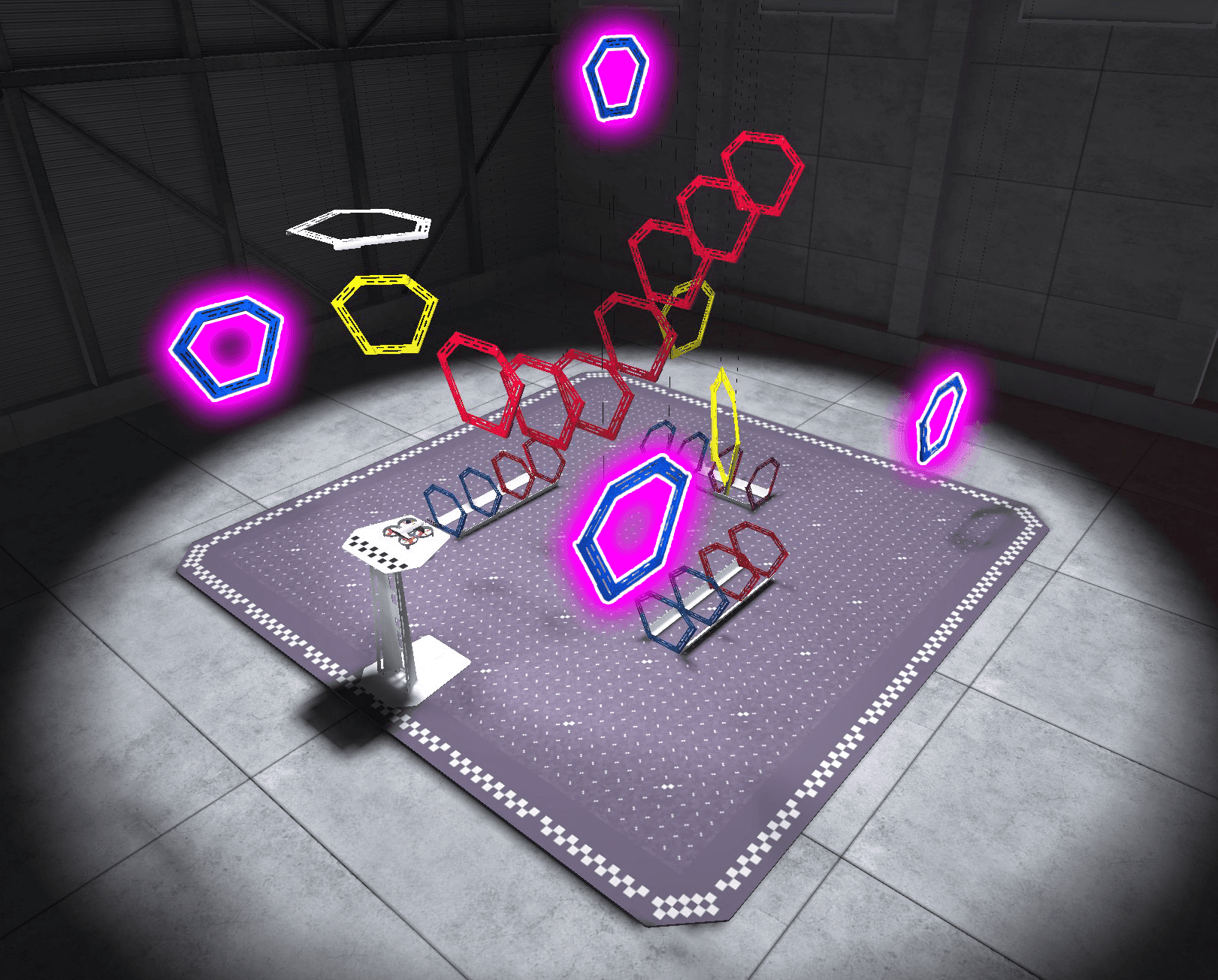
In this unit, you will explore the three movement modes on the VEX AIR Drone: Precision, Balanced, and Performance. Each mode offers different levels of responsiveness and stability during flight. You will practice flying through all of the blue rings using each movement mode, developing an understanding of the tradeoffs between speed and precision. This will help you choose the most effective mode for specific flight tasks.
Vocabulary
The key terms below will help you as you expand your flight controls. The vocabulary list is here to provide reference for key terms you may not be familiar with.
- Precision Mode — A flight mode that makes the drone move slowly and smoothly, helping the pilot stay in control
- Balanced Mode — A flight mode that gives a mix of speed and control
- Performance Mode — A flight mode that lets the drone fly faster and react quickly to controls
- Responsiveness — How quickly a drone reacts when the pilot moves the controls
- Stability Assist — A feature that helps keep the drone steady and balanced while flying. It makes flying easier by helping the drone stay level and resist shaking
The key terms below will help you as you expand your flight controls. The vocabulary list is here to provide reference for key terms you may not be familiar with.
- Precision Mode — A flight mode that makes the drone move slowly and smoothly, helping the pilot stay in control
- Balanced Mode — A flight mode that gives a mix of speed and control
- Performance Mode — A flight mode that lets the drone fly faster and react quickly to controls
- Responsiveness — How quickly a drone reacts when the pilot moves the controls
- Stability Assist — A feature that helps keep the drone steady and balanced while flying. It makes flying easier by helping the drone stay level and resist shaking
To help students internalize the meanings of the vocabulary in this unit, encourage them to explain what each word is, and is not. For example, precision mode is a mode that allows the pilot to fly slowly with control and accuracy, but isn't a mode that allows the drone to change direction instantly.
Select Next > to move to the next lesson.