
Preview
- Grade(s): 9-12
- Time: 1 week
Description
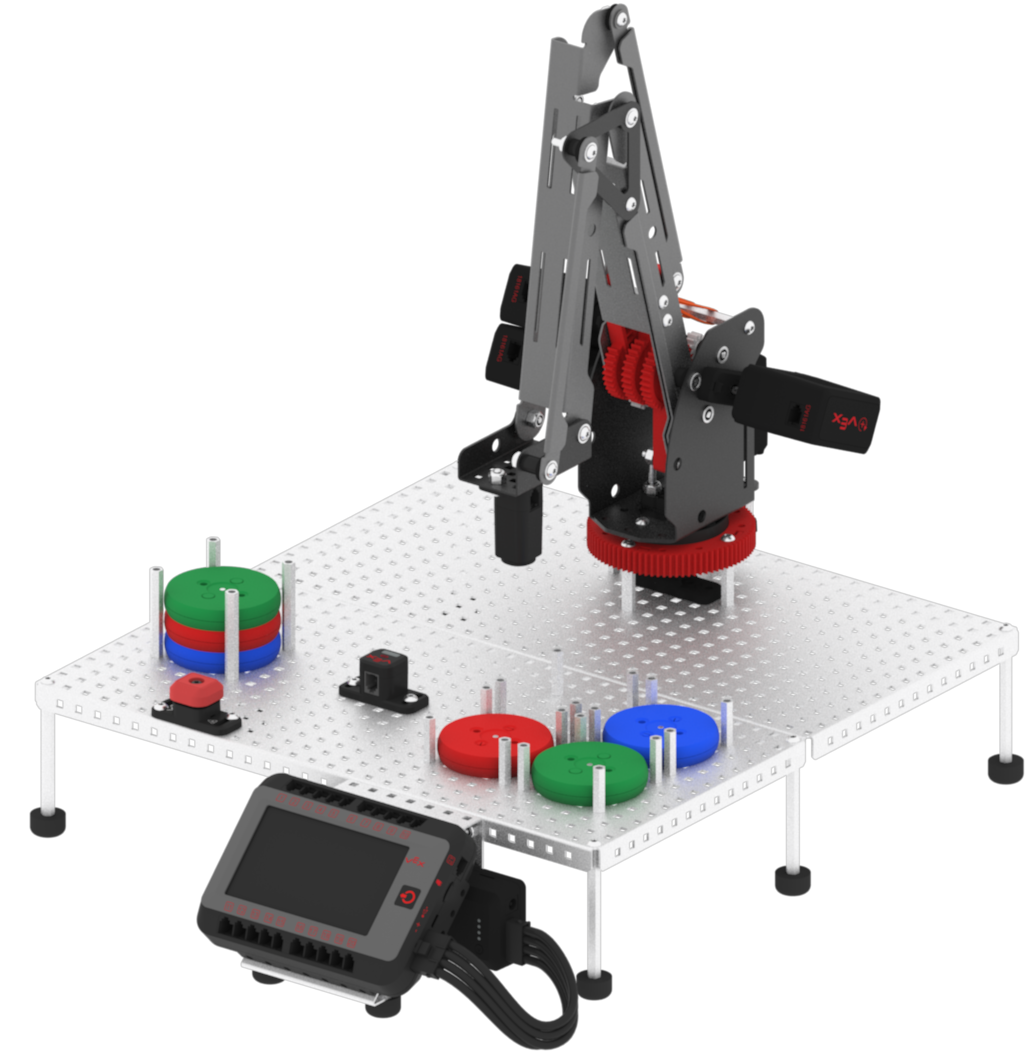
- Students will automate their VEX V5 Workcell using the Optical Sensor. Students will use an [If then] block to determine how the arm mounted on the V5 Workcell should move when each color is detected.
- Students will also explore how sensors are used in Industrial Robotics.
Essential Question(s)
- How do sensors affect the behavior of robots?
Understanding(s)
Students will understand:
- What are some of the advantages and disadvantages of using an Optical Sensor?
- What types of conditions would determine whether the robot will benefit from a vision sensor, a collision sensor, potentiometer, encoder, or limit switch?
Objective(s)
- Program the arm to select disks from a known location and use the Optical Sensor to place disks in a specific location.
- Identify different sensors and their functions contained inside and on the outside of a robot, including limit switches.
Vocabulary
- Vision Sensors
- These are sensors which rely on reflected wavelengths of light.
- Proximity Sensors
- These sensors determine how close objects are.
- Collision Detection Sensors
- These sensors work by the robot coming in contact with another object. They can measure a change in momentum or an amount of resistance to motion.
- Potentiometers
- These sensors work by being rotated and as they rotate they change the amount of electrical resistance of their signal. This allows a measurement of the absolute position of a shaft or joint of a robot. Absolute position means the robotic system can be powered off and then back on and the sensor reading will remain the same. The positioning of the arm mounted on the V5 Workcell depends a great deal on its potentiometers at each joint.
Note: there are LVDTs (Linear Variable Differential Transformer) which measure linear motion in a similar manner. - Encoders
- A type of sensor which can measure the rotation of a shaft. As a shaft rotates it will turn a disk with equally spaced holes. The disk has an optical sensor to count the amount of holes on the disk which pass by the sensor as the shaft turns. Encoders can be incremental sensors which will lose their count when the machine is turned off, or they can be absolute which means they always remember where they are.
- Limit Switch
- These types of sensors are known as contact sensors because when they are physically pressed they either complete or break a feedback signal to the robot controller indicating they are in contact with an object.
Materials Needed
| Quantity | Materials Needed |
|---|---|
| 1 |
VEX V5 Workcell |
| 1 |
Build Instructions |
| 1 |
VEXcode V5 |
| 1 |
Engineering Notebook |
| 1 |
Device to run VEXcode V5 |
| 1 |
Micro-USB cable |
| 3 |
Colored Disks (1x red, 1x blue, 1x green) |
Educational Standard(s)
- Next Generation Science Standards (NGSS) HS-ETS1-2: Design a solution to a complex real-world problem by breaking it down into smaller, more manageable problems that can be solved through engineering.
- Computer Science Teacher Association (CSTA) CSTA 3A-AP-18: Create artifacts by using procedures within a program, combinations of data and procedures, or independent but interrelated programs.
- Next Generation Science Standards (NGSS) HS-ETS1-4: Models (e.g., physical, mathematical, computer models) can be used to simulate systems and interactions—including energy, matter, and information flows—within and between systems at different scales.
- Computer Science Teacher Association (CSTA) CSTA 3A-AP-13: Create prototypes that use algorithms to solve computational problems by leveraging prior student knowledge and personal interests.
Go to this page in the Knowledge Base to see a cumulative list of VEX V5 Workcell STEM Labs standards.