You’ve learned how to code your robot to move at any angle to optimize its movement around obstacles. You iterated on a project to code your robot to move as precisely and quickly as possible. Now you're ready to apply everything you’ve learned by creating your own slalom course in the Unit Challenge. First, you will collaborate with your group to design your course. Then your group will code the robot to complete the slalom, iterating on your strategy to achieve your fastest possible time.
Watch the video to see an example slalom course and how to complete the challenge by driving through all the gates as quickly as possible.
Now that you have watched the video, capture your thoughts in your journal. Answer the questions below to guide your thinking and help you prepare for a whole-class discussion.
- How will you get started designing your slalom course?
- What are your initial ideas for navigating the course as quickly as possible? List at least two ideas in your journal.
- How do these ideas relate to how the robot moves?
- Why do you think your strategy will be effective? Use what you have learned throughout the course so far as evidence to support your ideas.
- What questions do you have about completing this challenge? List at least two in your journal.
Now that you have watched the video, capture your thoughts in your journal. Answer the questions below to guide your thinking and help you prepare for a whole-class discussion.
- How will you get started designing your slalom course?
- What are your initial ideas for navigating the course as quickly as possible? List at least two ideas in your journal.
- How do these ideas relate to how the robot moves?
- Why do you think your strategy will be effective? Use what you have learned throughout the course so far as evidence to support your ideas.
- What questions do you have about completing this challenge? List at least two in your journal.
Be sure that all students understand the goals of the challenge before beginning, and that they are formulating evidence-based strategies for completing the challenge. After students view the video, have a whole-class discussion about the challenge using students' answers to the questions as the basis.
In this challenge, students will first design their slalom course, and then code their robots to navigate the course as quickly as possible. As you are discussing the challenge with students, guide them towards the realization that their strategy for the challenge will be influenced by how the design of their slalom course and their coding project work together.
- The video shows one possible slalom setup. See the teacher note below for suggestions on how students can make creative slalom courses.
Remind students that they can apply everything they have learned so far in the course to complete the challenge. They can use journal entries from previous units, like path planning, to support their claims or to help them form and discuss initial strategies.
Because students are creating their own slaloms, they may need additional help in coming to group consensus. This video from VEX PD+ gives you guidance on helping students develop the habit of mind, thinking flexibly.
Complete the Challenge
Now that you've discussed the challenge, it's time to try it!
Step 1: Set up your slalom course on the field. One possible way to set up a slalom course is shown in the image below.
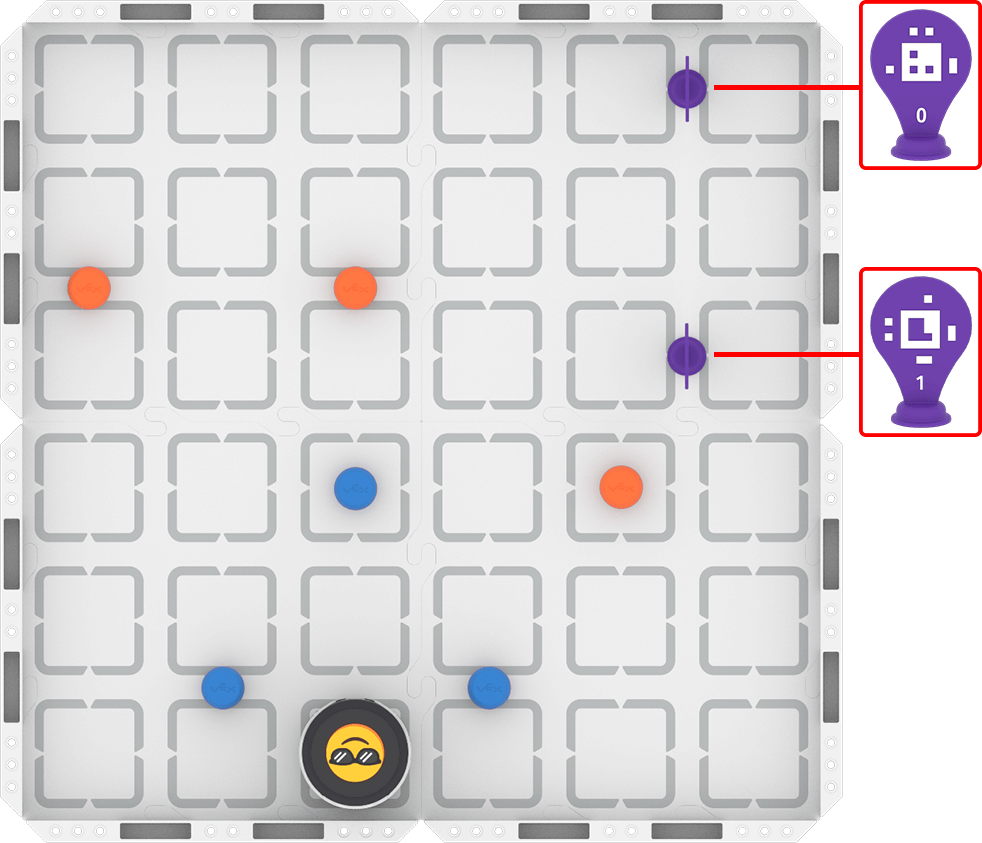
Step 2: Model the movements of the robot needed to complete the challenge using Drive mode.
- Your task is to drive the robot through the slalom course as quickly as possible. Document your driving strategy, then plan how you will code that movement.
- Use this task card (Google / .docx / .pdf) to guide your strategy development.
- Pro Tip: Think about how the setup of your slalom course, your driving, and your planned path can work together to help you optimize your time.
Step 3: Code the robot to complete the challenge.
- Your task is to use the shared strategy and path plan you developed in Step 2 to code the robot to drive through the barrel gates, finishing by driving through the AprilTag gates as quickly as possible.
- Use this task card (Google / .docx / .pdf) to guide your coding process.
- Pro Tip: Move back and forth between driving and coding as needed to help you optimize your time in this challenge. Document your driving and coding times, along with any changes you make, so you can use this information to get the fastest possible time.
Step 4: Explore! Move between driving and coding to iterate on your project and improve your strategy!
- Together with your group, brainstorm ways to make your project better.
- Drive the robot to test out your ideas, and choose one to start with.
- Iterate on your project to ensure it successfully completes the entire slalom course.
- Continue to move between driving and coding frequently to iterate on your project and find the best strategy to complete the challenge!
Now that you've discussed the challenge, it's time to try it!
Step 1: Set up your slalom course on the field. One possible way to set up a slalom course is shown in the image below.

Step 2: Model the movements of the robot needed to complete the challenge using Drive mode.
- Your task is to drive the robot through the slalom course as quickly as possible. Document your driving strategy, then plan how you will code that movement.
- Use this task card (Google / .docx / .pdf) to guide your strategy development.
- Pro Tip: Think about how the setup of your slalom course, your driving, and your planned path can work together to help you optimize your time.
Step 3: Code the robot to complete the challenge.
- Your task is to use the shared strategy and path plan you developed in Step 2 to code the robot to drive through the barrel gates, finishing by driving through the AprilTag gates as quickly as possible.
- Use this task card (Google / .docx / .pdf) to guide your coding process.
- Pro Tip: Move back and forth between driving and coding as needed to help you optimize your time in this challenge. Document your driving and coding times, along with any changes you make, so you can use this information to get the fastest possible time.
Step 4: Explore! Move between driving and coding to iterate on your project and improve your strategy!
- Together with your group, brainstorm ways to make your project better.
- Drive the robot to test out your ideas, and choose one to start with.
- Iterate on your project to ensure it successfully completes the entire slalom course.
- Continue to move between driving and coding frequently to iterate on your project and find the best strategy to complete the challenge!
Remind students of challenge expectations at the start.
- Students will engage in the same driving and coding process from the lessons to complete the unit challenge.
- Brainstorm with students how they will make sure that each group member contributes to both collaborative strategy development as well as coding.
Distribute the Step 2 task card (Google / .docx / .pdf) to students to guide them through creating their slalom course, and developing a collaborative strategy to complete the driving part of the challenge.
- Students will first need to collaborate to create their slalom course. You may want to have a discussion with students about how they will ensure everyone is in agreement about their course design.
- Not all students may be familiar with the idea of a slalom. If needed, have a discussion about what a slalom is, or share a video of a ski or kayak slalom with students.
- Encourage students to be creative with their courses! They can change the layout of the tiles, or even create their course on a table or floor. Two groups could even combine their fields to make a larger area for the slalom.
- Slalom courses can contain three gates made with barrels, and one AprilTag gate (the finish gate). If students need a simpler challenge, have them remove one barrel gate.
As you circulate through the room, check in with each group to see how they are sharing and collaborating on a challenge strategy. Ask questions like:
- What have you tried so far? Was it successful? Why or why not?
- What is one thing you think you can improve on to make your collaborative strategy better than an individual one? Why do you think that will help?
- How is your group collaborating to develop a strategy or plan about your project?
Ensure all groups can explain their strategy to you before moving on to coding their projects in Step 3. Give a signal to the class to let them know when it is nearing time to wrap up and move on to the next step. Remind them they can return to Drive mode at any time to help them complete the challenge.
Distribute the Step 3 task card (Google / .docx / .pdf) to students to guide them through collaborative coding to complete the challenge.
Circulate around the room as students are coding, and engage them in conversations about their process and progress. Ask questions like:
- How are you creating your coding project to ensure you complete the slalom as quickly as possible? How is your documentation helping you to do so?
- What challenges are you facing as you create your project? How are you using driving to help you solve those challenges?
- How is your group collaborating to code and document your challenge project?
Students can move onto Step 4 once they have completed an initial project to complete the task. They should move freely and frequently between driving and coding to improve their projects. Encourage students to reflect on the reasoning behind each iterative change they make. Ask questions like:
- What about your strategy are you trying to improve? What is your goal for this iteration?
- Why do you think your idea will be successful? How will you know?
- How are you going to work together to implement that change? What role will each group member play in this iteration?
In a unit challenge, you can determine when it is time to end the challenge and transition students into sharing their learning. Once you feel that all groups have had time to complete the challenge effectively and iteratively, wrap up the challenge phase and move on to strategy sharing.
Share Your Strategy
Once everyone has completed the challenge, it’s time to share your strategy with the class. To prepare for this sharing session, answer the following questions in your journal:
- Describe your final strategy for completing the challenge. Why was it successful?
- How did your slalom course design affect the time it took to complete the course? What evidence do you have for this?
- How did your group collaborate to develop that strategy together?
- How did you apply what you learned in the unit (or the course) to complete the challenge? Be specific in your answers.
- Do you think your strategy was the best way to complete the challenge on your course? Why or why not?
Once everyone has completed the challenge, it’s time to share your strategy with the class. To prepare for this sharing session, answer the following questions in your journal:
- Describe your final strategy for completing the challenge. Why was it successful?
- How did your slalom course design affect the time it took to complete the course? What evidence do you have for this?
- How did your group collaborate to develop that strategy together?
- How did you apply what you learned in the unit (or the course) to complete the challenge? Be specific in your answers.
- Do you think your strategy was the best way to complete the challenge on your course? Why or why not?
Once everyone has completed the challenge, come together for a whole-class strategy sharing session and discussion. This is an opportunity to highlight the interplay of driving and coding to solve the challenge. It is also a chance to help students explore how students' slalom course designs and what they learned in the unit influenced their coding projects and strategy. Continue to encourage students to support their claims with evidence.
The discussion should center around the final bullet – Do you think your strategy was the best way to complete the challenge? Why or why not? By the end of the discussion, the class should have consensus on what the best approach means to them.
- Begin with one group sharing their strategy or demonstrating their project for the class, and presenting their answers to the questions.
- Other groups then respond to what was shared, using their strategy for the project and journal documentation as evidence to support their claim.
- Encourage students to think more deeply about what "best" means in the context of this challenge. The goal of the challenge is to optimize the time it takes to complete the challenge, but the design of the slalom course has a direct effect on this. Given the variety of slalom courses used across the class, what conclusions can you come to as a class about what best is in this instance? What evidence can be used to support these conclusions?
Remind students of classroom expectations for respectful discussion, and encourage them to agree or disagree using evidence, not judgment.
Reflect and Share
At the start of this unit, you co-created learning targets with your teacher. Once you have completed the challenge, it is time to reflect on your progress toward those learning targets.
For each of your learning targets, complete the following sentences in your journal:
- At first, I thought ___________ because ___________.
- Now that we've completed the unit challenge, I understand ___________.
- My evidence for this new understanding is ___________, which shows ___________.
Check in with your teacher when you have completed the sentences for each learning target. This reflection will help you share your learning.
At the start of this unit, you co-created learning targets with your teacher. Once you have completed the challenge, it is time to reflect on your progress toward those learning targets.
For each of your learning targets, complete the following sentences in your journal:
- At first, I thought ___________ because ___________.
- Now that we've completed the unit challenge, I understand ___________.
- My evidence for this new understanding is ___________, which shows ___________.
Check in with your teacher when you have completed the sentences for each learning target. This reflection will help you share your learning.
Remember, the purpose of Reflect and Share is to guide students to:
- Evaluate their progress toward each learning target, using evidence from their journals to support their claims.
- Guide the class as a whole to converge their thinking around the unit understandings.
- Relate their learning to real-world applications.
First, students will complete the sentences to reflect on their progress toward each of their learning targets.
Next, engage students in a whole-class discussion by inviting students to share what they wrote in their journals. Guide students towards shared conclusions about each of the unit understandings, using prompts like:
- Which explanation best matches the observations we collected throughout the unit? How do we know?
- Is there evidence that makes one explanation stronger than the others? Why?
- Can we agree on one explanation based on our combined evidence and discussions throughout the unit? Why or why not?
Once you have guided students' thinking to converge around the unit understandings, you may want to create or add to class artifacts that display the class's shared understandings for students to refer to moving forward.
Finally, students should relate their learning to the real-world connections they brainstormed at the beginning of the unit. Guide the discussion with questions like:
- What connections can you make between our learning today and the experiences you shared earlier from outside the classroom? How does what you learned apply to real-world scenarios? (Student answers will vary depending on their relevant experience.)
Select Return to Units > to go back to all Units.