Before You Begin
In this unit, students will be challenged to earn a high score as they deliver cargo, precisely place orbit balls, and fly through rings in the VEX AIR Flight Simulator. In this open-ended challenge, students will be given a process to follow in order to plan, practice, and iterate on their strategies for piloting the VEX AIR Drone with the VEX AIR Drone Controller.
Be sure students have the following ready for use before you begin:
- A charged VEX AIR Drone Controller
- A USB-C cable
- A computing device with access to VEXcode AIR
Learning Objectives:
- Develop and execute a flight plan that meets the requirements of an open-ended mission.
- Demonstrate controlled flight using pitch, roll, yaw, and throttle in combination.
- Use simulator tools such as camera views, controller data, and module controls to support navigation.
- Demonstrate safe and intentional pickup, transport, and release of payloads using the appropriate module.
- Evaluate flight attempts and make adjustments based on observed outcomes.
- Demonstrate persistence by refining strategies across multiple attempts.
Standards Alignment
Common Core English Language Arts (CCSS ELA)
CCSS.ELA-LITERACY.CCRA.L.6 - Acquire and use accurately a range of general academic and domain-specific words and phrases sufficient for reading, writing, speaking, and listening at the college and career readiness level; demonstrate independence in gathering vocabulary knowledge when encountering an unknown term important to comprehension or expression.
CCSS.ELA-LITERACY.RST.9-10/11-12.3 - Follow precisely a complex multistep procedure when carrying out experiments, taking measurements, or performing technical tasks, attending to special cases or exceptions defined in the text.
CCSS.ELA-LITERACY.RST.9-10/11-12.4 - Determine the meaning of symbols, key terms, and other domain-specific words and phrases as they are used in a specific scientific or technical context relevant to grade level topics.
International Society for Technology in Education (ISTE)
Empowered Learner – 1.1.c – Students use technology to seek feedback that informs and improves their practice and to demonstrate their learning in a variety of ways.
Empowered Learner – 1.1.d – Students understand fundamental concepts of how technology works, demonstrate the ability to choose and use current technologies effectively, and are adept at thoughtfully exploring emerging technologies.
Knowledge Constructor – 1.3.d – Students build knowledge by exploring real-world issues and gain experience in applying their learning in authentic settings.
Innovative Designer – 1.4.d – Students exhibit a tolerance for ambiguity, perseverance and the capacity to work with open-ended problems.
Global Collaborator - 1.7.c - Students contribute constructively to project teams, assuming various roles and responsibilities to work effectively toward a common goal.
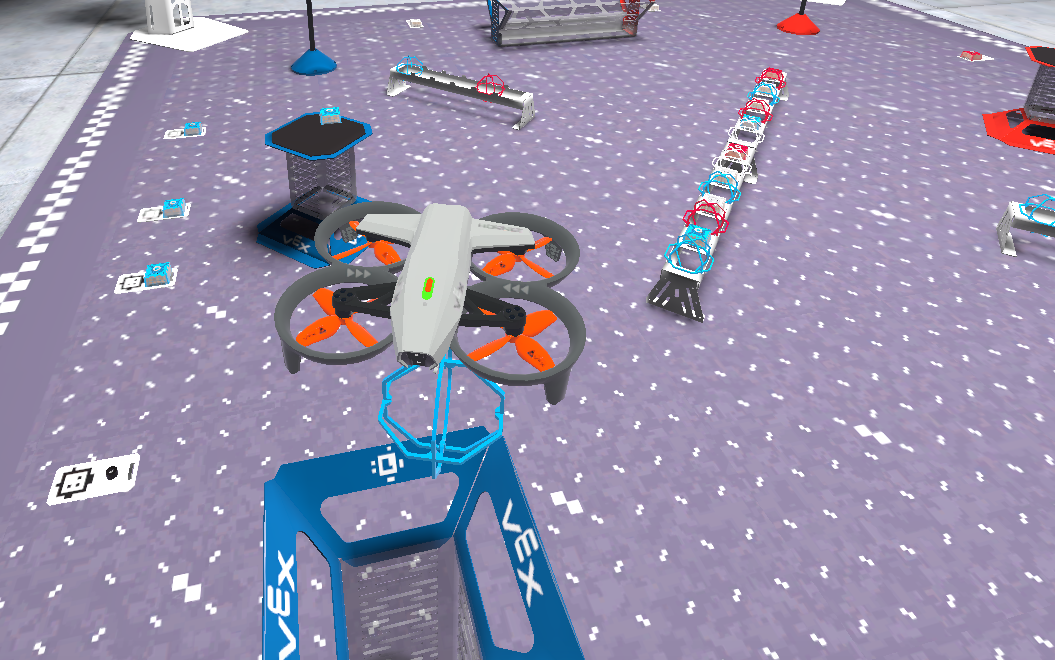
Congratulations! Through hard work and practice, you have learned to fly the VEX AIR Drone in the VEX AIR Flight Simulator. Now it is time to take all of the skills you have built throughout the course and apply them to a Capstone Mission. Use the VEX AIR Drone Controller to maximize your score in this timed Competition layout challenge. You will need to score at least once using the Magnet Module and once using the Motorized Hook Module. To score the most points possible, you will develop a strategic flight plan, test it through trial runs, refine your approach based on what you learn, and then take to the air for your final mission!
Watch the video below to learn more about the Capstone Mission, including:
- Turning on the Propeller Lock with the controller.
- Switching modules during a flight.
Congratulations! Through hard work and practice, you have learned to fly the VEX AIR Drone in the VEX AIR Flight Simulator. Now it is time to take all of the skills you have built throughout the course and apply them to a Capstone Mission. Use the VEX AIR Drone Controller to maximize your score in this timed Competition layout challenge. You will need to score at least once using the Magnet Module and once using the Motorized Hook Module. To score the most points possible, you will develop a strategic flight plan, test it through trial runs, refine your approach based on what you learn, and then take to the air for your final mission!
Watch the video below to learn more about the Capstone Mission, including:
- Turning on the Propeller Lock with the controller.
- Switching modules during a flight.
Use students' excitement about this final mission to help get students focused and engaged on the task at hand. The Capstone Mission is intentionally open-ended and may feel challenging or unfamiliar to students at first. Use this moment to frame persistence as an essential piloting skill that students will practice throughout the mission and in real life. Emphasize that progress comes from trying, adjusting, and trying again.
Before students begin, help them understand that repeated attempts, thoughtful adjustments, and steady focus are expected and valued. Frame persistence as an essential professional skill, emphasizing that complex problem-solving and decision-making require patience, flexibility, and confidence that develop over time through practice.
Creating a visible class-wide reminder to be persistent (via a poster, smaller reminder notes, etc.) can help to give students something to remind them of the value of iterating throughout the mission.
Select Next > to begin the Capstone Mission.