You've learned how to code your robot to turn and move in order to transport cargo successfully. You learned about heading, and how to use headings to navigate around the field in order to precisely and efficiently move and manipulate barrels and sports balls. Now you're ready to apply everything you've learned in a timed cargo transport mission! You will collaborate with your group to strategize and plan how to move all four barrels to AprilTag ID 0. Then you will work together to code the robot to complete the challenge, iterating on your project and strategy to transport the cargo as quickly as possible.
Review the challenge by watching the video below, and think about how you will complete the challenge with your group.
Now that you have watched the video, capture your thoughts in your journal. Answer the questions below to guide your thinking and help you prepare for a whole-class discussion.
- What are your initial strategy ideas for completing this challenge? List at least two ideas in your journal with details.
- Why do you think your strategy will be successful? Use what you have learned throughout the course so far to support your claim.
- Do you think there are other ways to complete the challenge? Why or why not?
- What questions do you have about completing the challenge? List at least two in your journal.
Now that you have watched the video, capture your thoughts in your journal. Answer the questions below to guide your thinking and help you prepare for a whole-class discussion.
- What are your initial strategy ideas for completing this challenge? List at least two ideas in your journal with details.
- Why do you think your strategy will be successful? Use what you have learned throughout the course so far to support your claim.
- Do you think there are other ways to complete the challenge? Why or why not?
- What questions do you have about completing the challenge? List at least two in your journal.
Come together for a whole-class discussion after students have viewed the video. Ensure students are clear on the challenge goal before beginning, and use their answers to the questions to get the discussion started.
Guide students to make the connection between the precision of their movements and the overall timing of their project. The order in which they move the barrels, and the path their robot takes to move all four objects can have an effect on their overall speed. Remind students that iteration is key in a unit challenge, and that in this challenge, their iterations will likely center around balancing speed with precision.
Remind students that they can reference their journals from the whole course to inform their discussions and choices during the challenge.
If you think students will need additional support with making collaborative, data based decisions during this challenge, view this video from the PD+ Video Library to help you guide students.
Complete the Challenge
Now that you've discussed the challenge, it's time to try it!
Step 1: Set up your field as shown here. 
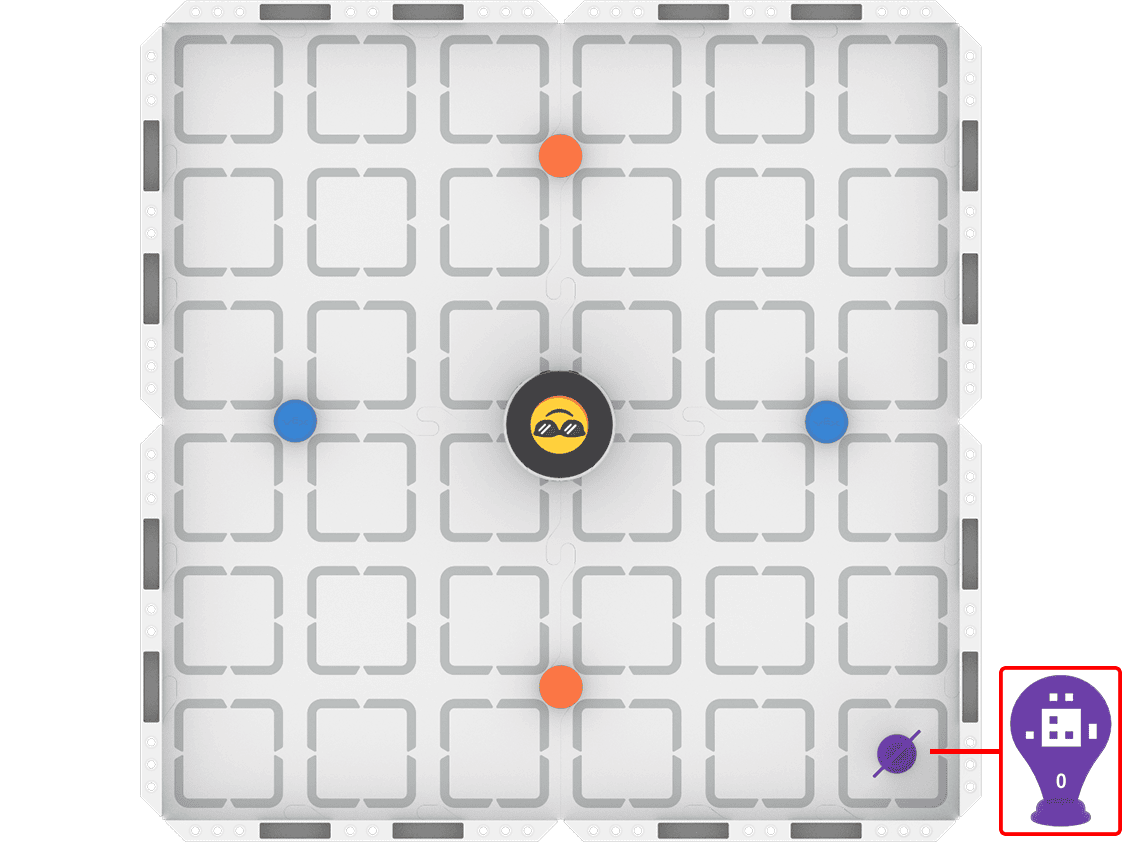
Step 2: Model the movements of the robot needed to complete the challenge using Drive mode.
- Your task is to drive the robot to pick up and deliver all four barrels to AprilTag ID 0 as quickly as possible. Document your driving strategy, and plan how you will code that movement.
- Use this task card (Google / .docx / .pdf) to guide your strategy development. You can use the Path Planning Sheet to help document as well.
- Pro Tip: Document how long each of the paths you test takes to complete the challenge. You can use that data to help your group make a data based decision about your strategy and path plan.
Step 3: Code the robot to complete the challenge.
- Your task is to use the shared strategy and path plan you developed in Step 2 to code the robot to pick up and deliver all four barrels to AprilTag ID 0 as quickly as possible.
- Use this task card (Google / .docx / .pdf) to guide your coding process.
- Pro Tip: Pay attention to the orientation of your robot at the start of your project, and remember to keep your Robot Protractor aligned with that starting position to help you use headings effectively.
Step 4: Explore! Move between driving and coding to iterate on your project and improve your strategy!
- Together with your group, brainstorm ways to make your project better.
- Drive the robot to test out your ideas, and choose one to start with.
- Iterate on your project to ensure it successfully completes the task.
- Continue to move between driving and coding frequently to iterate on your project and find the best strategy to complete the challenge!
Now that you've discussed the challenge, it's time to try it!
Step 1: Set up your field as shown here. 
Step 2: Model the movements of the robot needed to complete the challenge using Drive mode.
- Your task is to drive the robot to pick up and deliver all four barrels to AprilTag ID 0 as quickly as possible. Document your driving strategy, and plan how you will code that movement.
- Use this task card (Google / .docx / .pdf) to guide your strategy development. You can use the Path Planning Sheet to help document as well.
- Pro Tip: Document how long each of the paths you test takes to complete the challenge. You can use that data to help your group make a data based decision about your strategy and path plan.
Step 3: Code the robot to complete the challenge.
- Your task is to use the shared strategy and path plan you developed in Step 2 to code the robot to pick up and deliver all four barrels to AprilTag ID 0 as quickly as possible.
- Use this task card (Google / .docx / .pdf) to guide your coding process.
- Pro Tip: Pay attention to the orientation of your robot at the start of your project, and remember to keep your Robot Protractor aligned with that starting position to help you use headings effectively.
Step 4: Explore! Move between driving and coding to iterate on your project and improve your strategy!
- Together with your group, brainstorm ways to make your project better.
- Drive the robot to test out your ideas, and choose one to start with.
- Iterate on your project to ensure it successfully completes the task.
- Continue to move between driving and coding frequently to iterate on your project and find the best strategy to complete the challenge!
Review challenge expectations with students to begin. Be sure that students are clear on their roles and expectations for collaboration during the challenge.
To learn more about supporting students productive struggle during open-ended challenges, read this Insights article to help you facilitate the unit challenge.
Distribute the Step 2 task card (Google / .docx / .pdf) to students to guide them through the path planning and driving part of the challenge. Be sure each group has access to a Robot Protractor and/or the Path Planning Sheet as they are planning, driving, and coding.
As students are driving and developing their strategies, circulate around the room and engage students in discussions about their path planning. Ask questions like:
- How are you determining if a strategy idea is successful? What makes one idea better than another?
- How is your path plan capturing all the details about your robot's movements?
- Is precision important when you're driving to complete this challenge? Why or why not?
Distribute the Step 3 task card (Google / .docx / .pdf) to students once they have checked in with you and met the success criteria for driving and path planning.
While students are working on their projects, circulate around the room to check in on their process and progress with the challenge. Ask questions like:
- How many barrels have you moved so far? What is your next step? Why?
- What details about your plan are you paying particular attention to when you code? Was your path plan sufficient? Why or why not?
- How are you using driving to help you be precise in your code?
- How are you collaborating to build and test your project incrementally? What is a collaboration strategy that is working well for you?
Students can move on to Step 4 once they have a coding project that completes the challenge. They should seek to improve and iterate on their projects to accomplish the task in less time, or make their project better in some way. Be sure groups are in agreement about what they are trying to improve about their project, to ensure they are iterating effectively.
Encourage students to seek inspiration for iteration from other groups as well as their own. Remind students that they can look at other groups' code and strategies to help them think differently about their own project.
As you circulate around the room while students iterate, ask questions like:
- Where did you get this iteration idea? Why did you choose it together?
- How will this idea make your project better? What makes you say that?
- How are you documenting your iteration? Why is it important to document changes to your plan and project?
In a unit challenge, you can determine when it is time to end the challenge and transition students into sharing their learning. Once you feel that all groups have had time to complete the challenge effectively and iteratively, wrap up the challenge phase and move on to strategy sharing.
Share Your Strategy
Once everyone has completed the challenge, it's time to share your strategy with the class. To prepare for this sharing session, answer the following questions in your journal:
- What was your final strategy for this challenge? Why do you think it was successful?
- How did your strategy evolve from the start of the challenge to the end? Why did you make those changes?
- What is the most useful thing you've learned so far in this course that helped you complete the challenge? How did you apply that learning to your project?
- Do you think your strategy was the best way to complete the challenge? Why or why not?
Once everyone has completed the challenge, it's time to share your strategy with the class. To prepare for this sharing session, answer the following questions in your journal:
- What was your final strategy for this challenge? Why do you think it was successful?
- How did your strategy evolve from the start of the challenge to the end? Why did you make those changes?
- What is the most useful thing you've learned so far in this course that helped you complete the challenge? How did you apply that learning to your project?
- Do you think your strategy was the best way to complete the challenge? Why or why not?
Once everyone has completed the challenge, come together for a whole-class strategy sharing session and discussion. Remind students of expectations for respectful discourse and active listening strategies.
By the end of the discussion, students should have viewed all of the strategies and engaged in discourse to come to consensus about what the best approach for this challenge means for them. Encourage students to think about what “best” means in the context of this challenge. Timing is important, but what other factors or criteria could also be used? If students struggle to identify other criteria, ask what they would use as a tiebreaker if two projects finished at the same time.
Reflect and Share
At the start of this unit, you co-created learning targets with your teacher. Once you have completed the challenge, it is time to reflect on your progress toward those learning targets.
For each of your learning targets, complete the following sentences in your journal:
- To begin, I thought ________ because ________.
- Now that we've completed the unit challenge, I understand ________.
- My evidence for this understanding is ________, which shows ________.
Check in with your teacher when you have completed the sentences for each learning target. This reflection will help you share your learning.
At the start of this unit, you co-created learning targets with your teacher. Once you have completed the challenge, it is time to reflect on your progress toward those learning targets.
For each of your learning targets, complete the following sentences in your journal:
- To begin, I thought ________ because ________.
- Now that we've completed the unit challenge, I understand ________.
- My evidence for this understanding is ________, which shows ________.
Check in with your teacher when you have completed the sentences for each learning target. This reflection will help you share your learning.
Once students have completed their reflections in their journals, come together for a whole-class discussion. Invite students to share what they wrote in their journals, and guide students toward shared conclusions about each of the unit understandings or learning targets. Ask questions like:
- Do your observations and practice match that explanation? Why or why not?
- Is one explanation clearer or stronger than another? Why?
- What are some common ideas that we hear about this concept? Can we agree on one shared idea based on our combined evidence and discussions throughout the unit? Why or why not?
Once you have guided students to converge their thinking around unit understandings, you may want to create or add to the evidence of students' learning around the classroom, for students to refer to moving forward.
Finally, students should relate their learning to the real-world connections they brainstormed at the beginning of the unit. Guide the discussion with questions like:
- What connections can you make between our understandings today and the real-world examples or experiences we talked about earlier? How does that example demonstrate your learning in a real-world context? (Student answers will vary depending on their relevant experience.)
Select Return to Units > to go back to all Units.