VIQRC Session 4
Before You Begin This Session
This session will guide your team through developing their first game strategy. Working in the drive teams formed during the previous session, students will follow a process designed to deepen their understanding of the game and help them brainstorm and test possible strategies.
Each drive team will agree on a strategy to try, then test it out—collecting data on how well their strategy performs. After testing, the full team will come together to share experiences and make collaborative, data-driven decisions about which strategies to carry into their first competition.
Throughout this session, your primary role is to facilitate conversations around strategy development. In the Coach Notes, you’ll find guiding questions to help your team approach strategy building with creativity and intention. You'll also remind students to document their ideas and data in the engineering notebook.
The PD+ Insights article, A New Way to Define “Defining the Problem” may be useful to you as a resource to help your students create their initial game strategies. The ideas in that article are adapted from the book What If? Building Students’ Problem-Solving Skills Through Complex Challenges, by Ronald A. Beghetto, which is another excellent resource.
Have your kit and materials ready for the session before you begin. You will need the following:
- A built Hero Bot.
- Charged controller and batteries.
- A built VIQRC Mix and Match Competition Field.
- An engineering notebook.
Review strategies for implementing this STEM Lab with your team.
- Use the Implementing a Competition 101 STEM Lab article to help you prepare and facilitate this session.
- The Strategies for Introducing a VIQRC Game article provides suggestions for introducing scoring tasks in a scaffolded way, to help students develop a strategy that works for them.
- Read the Making Competition 101 STEM Labs Work For All Students article for ways to adapt, or differentiate, session content to meet varying student needs.
- Review the considerations in the Cultivating a Positive Team Culture article to support your teams' growing collaboration skills.
Now it is time to begin developing your team's first strategy for playing VIQRC Mix & Match. A strategy is a plan for how to reach a goal. In this case, the goal is achieving the most possible points in VIQRC Mix & Match! There are many possible strategies for playing the game! It's more than just building, driving and coding the robot — it's thinking about the game like a puzzle and figuring out the smartest way to solve it.
A good strategy:
- Makes your robot's strengths stand out.
- Helps you earn more points efficiently.
- Prepares your team for surprises.
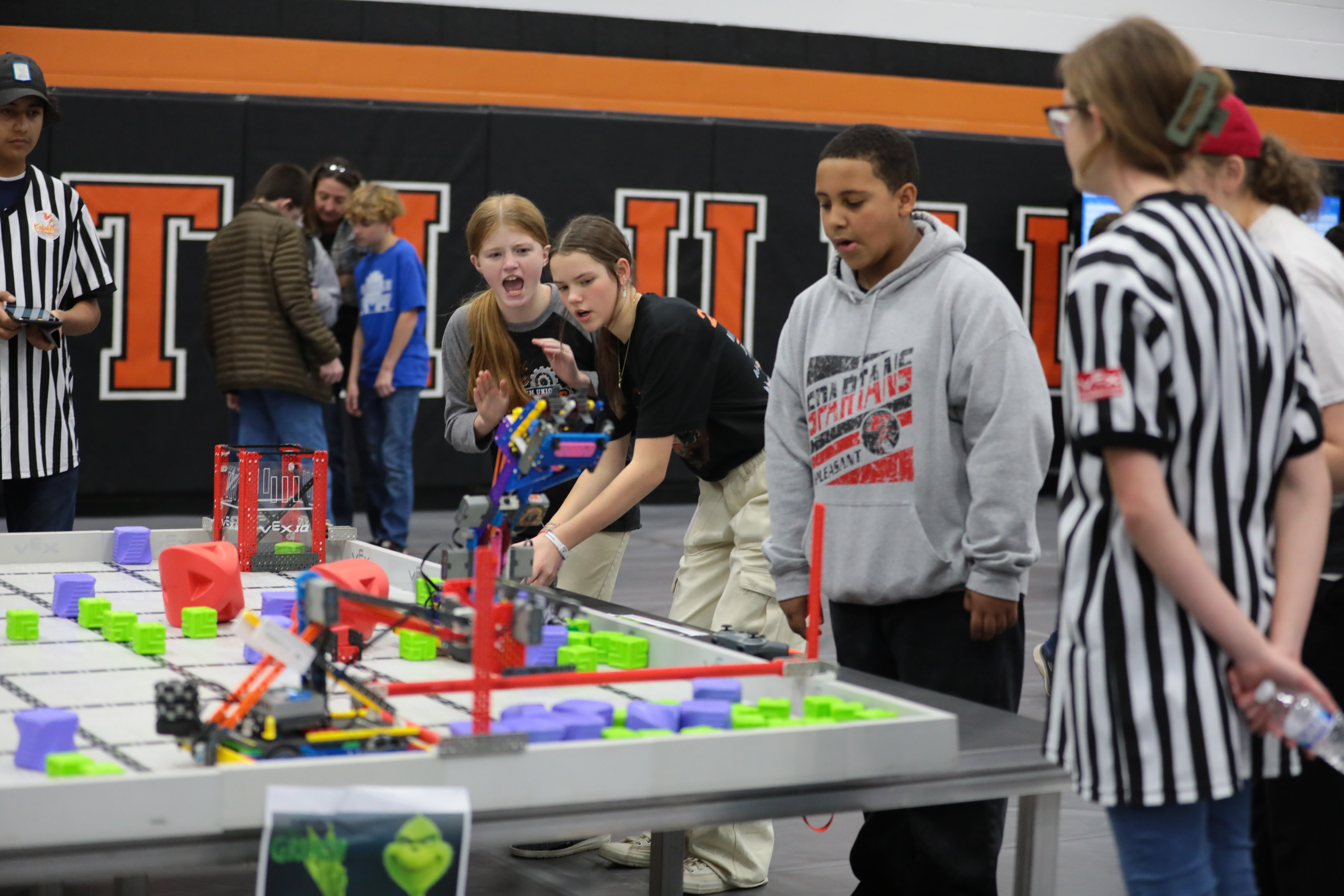
In this session, you are going to learn a process to help you develop a strategy for the competition. Your first strategy is just a starting point! It will grow and improve over the course of the season.
- A built Hero Bot.
- Charged controller and batteries.
- A built VIQRC Mix & Match Competition Field.
- An engineering notebook.
Developing Strategies
Get started thinking strategically by watching this video.
In this video, you will learn about:
- What a strategy is.
- A process for developing a strategy.
- How simple games can help you practice thinking about a strategy.
Get started thinking strategically by watching this video.
In this video, you will learn about:
- What a strategy is.
- A process for developing a strategy.
- How simple games can help you practice thinking about a strategy.
The familiar game of tic-tac-toe introduces a problem-solving process that students can apply during this session's activities to develop their first game strategy. Be sure to watch the video along with students for an example of this process which is described briefly below:
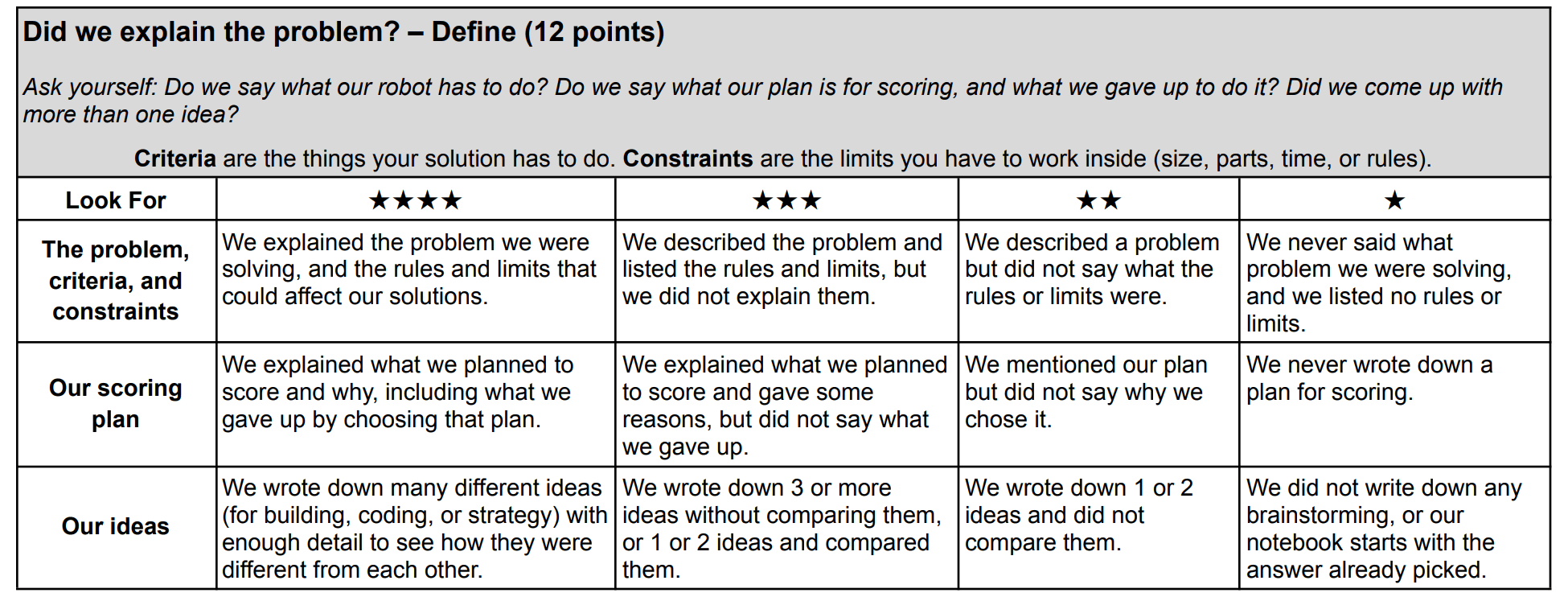
- STOP to deeply consider the challenge. Examine what you already know about the game, including the rules and constraints of the game, and what you still need to find out.
- THINK about all the possible solutions, or strategy options, for the game. Generate as many as you can without evaluating them at first. Consider all the ideas, then narrow them down into one or two to try. Don't forget to consider the possible consequences of any strategy choice, such as how the opposing team, or an alliance partner may respond.
- TEST possible strategy ideas, and record data about how they work in the engineering notebook. Quantitative data, like the number of points scored or the time it takes to execute a particular part of the strategy should be noted.
- EVALUATE the success of the strategy. Did it meet the team's expectations? Decide what worked and what didn't, and apply this feedback to the next round of strategy development.
Activity: Dots and Boxes
After watching the video, you are going to practice strategy development using a familiar pencil and paper game, Dots and Boxes.
Use this task card (Google Doc / .pdf / .docx) to help you complete the activity.
Apply the process from the video to develop a strategy to play Dots and Boxes.
After watching the video, you are going to practice strategy development using a familiar pencil and paper game, Dots and Boxes.
Use this task card (Google Doc / .pdf / .docx) to help you complete the activity.
Apply the process from the video to develop a strategy to play Dots and Boxes.
In this activity, students practice applying a problem-solving process by creating a strategy for playing an individual game of Dots and Boxes. Help students to use the questions on the task card to:
- Build a deep understanding of the rules of the game
- Generate as may strategy ideas as possible.
As students engage in the activities in this session, help guide them through each section of the process by asking follow-up questions that encourage their understanding and boost their creativity.
For the Stop phase, follow up with questions like:
- How do you know you understand the rules thoroughly?
- Where might you find answers to any questions you have about the rules of the game?
- How would you describe the rules of this challenge to someone else?
When they are in the Think phase of the process, encourage students to ask “What if?” questions. To help them generate as many ideas as possible, try questions like:
- Try to think of an idea that nobody else would think of - what would that look like?
- Imagine how someone else you know might approach this game - what might their strategy idea be?
When you ask students questions like this, you are helping them to come up with their own thoughts and ideas without interjecting any of your own, which is the goal of the student-centered policy.
For additional support with adhering to the student-centered policy in this session, see the Game Strategy and Match Play section of the policy.
Activity: Develop a Team Strategy
In the last activity, you practiced developing a strategy to play a game. In this activity, you will build on what you learned to create a team strategy for playing VIQRC Mix & Match.
Use this task card (Google doc / .pdf / .docx) to guide you through this activity.
- Use the questions on the task card to help you plan your strategy and collect your data.
- Record data about the game tasks that make up your strategy in your engineering notebook. You can use the example in the task card to help you set up your documentation.
- Check the game manual while you practice to determine how many points each task would earn your team.
In the last activity, you practiced developing a strategy to play a game. In this activity, you will build on what you learned to create a team strategy for playing VIQRC Mix & Match.
Use this task card (Google doc / .pdf / .docx) to guide you through this activity.
- Use the questions on the task card to help you plan your strategy and collect your data.
- Record data about the game tasks that make up your strategy in your engineering notebook. You can use the example in the task card to help you set up your documentation.
- Check the game manual while you practice to determine how many points each task would earn your team.
This activity is designed to ease students into applying the process to develop a collaborative team strategy for playing the game. They will engage in ‘Stop-Think-Test-Evaluate’ in their drive teams first, with the goal of choosing their best strategy to present to the whole team during the Wrap-Up section of the session.
- The questions provided in the task card are meant to guide students' thinking. Depending on your students, you may need to be more involved in facilitating this activity. Tailor the task card to best meet the needs of your students. You can complete this activity individually or as a whole group guided discussion.
Your role as coach is to facilitate by asking guiding questions, both about the process, and the collaborative decision making needed. The suggested questions provided above for the ‘Stop’ and ‘Think’ steps of the process will continue to be helpful.
When students are testing their strategy, ensure they are collecting data in their engineering notebooks that they will be able to use to both choose their best strategy and to support it when sharing it with the rest of the team.
When students are evaluating the effectiveness of their strategy, facilitate by asking follow-up questions like these:
- What specific changes do you want to make to your strategy moving forward?
- How can you keep the successful parts of your strategy and improve the parts that weren't as helpful?
- How do you know this aspect of your strategy was successful? What data do you have to show it?
Remember - strategy development is an iterative process! Your team will need to go through this process continuously over the course of the season, and will experience setbacks and frustration. Support them by reminding them that it is okay to feel frustrated, but that it is important to view failures as opportunities to learn and grow.
The following videos from VEX PD+ may be also helpful in developing students' growth mindsets. Consider watching them and applying some of the strategies shared in the videos to your coaching practice throughout the season.
Wrap Up
Now it is time to come together as a whole team to share your strategies. You will make a collaborative decision about the best one to use for now. Team members may have different ideas about the best strategy and that is a good thing! Having many creative options will strengthen your team's strategy in the long run!
Make a collaborative decision about your first game strategy:
- Have each drive team share their strategy and data.
- Use the data to help you agree on the best option.
As you discuss, think about good communication tools and strategies to help you make decisions as a team. Watch the video below to learn more about making collaborative, data-based decisions.
Once you have decided on your team's first strategy for VIQRC Mix & Match, it's time to try it out! Choose a drive team to complete a 1 minute trial run of your new strategy on the Field.
Now it is time to come together as a whole team to share your strategies. You will make a collaborative decision about the best one to use for now. Team members may have different ideas about the best strategy and that is a good thing! Having many creative options will strengthen your team's strategy in the long run!
Make a collaborative decision about your first game strategy:
- Have each drive team share their strategy and data.
- Use the data to help you agree on the best option.
As you discuss, think about good communication tools and strategies to help you make decisions as a team. Watch the video below to learn more about making collaborative, data-based decisions.
Once you have decided on your team's first strategy for VIQRC Mix & Match, it's time to try it out! Choose a drive team to complete a 1 minute trial run of your new strategy on the Field.
During the Wrap-Up, each drive team should share their best strategy from the previous activity. Then the team should make a collaborative decision about which strategy they want to adopt as their initial strategy for the game. Review this article to help you keep the positive team culture at the forefront during collaborative decision making discussions.
Students may find they want to combine elements of several strategies, and that is great! The following guiding questions may help if students get stuck during this discussion:
- Of all the strategy ideas presented, which do you think is the best, and why?
- What data are you using to make your decisions?
- If you combine the best parts of multiple strategy ideas, can you come up with a stronger strategy?
- Do you see any possible issues with your chosen strategy? What ideas do you have for solving them?
Once students have settled on a strategy, end the session with some excitement and motivation by giving students time to test it out on the Field with their robot!
Select Next Session > to move on to the next session.