
Play
Part 1 - Step by Step
- InstructInstruct students that they are going to participate in the Village Construction competition with their Hero Robots. First, they will practice for the competition by remote control driving the Hero Robot to lift and transport house components from the trailers to the red tile. Then there will be the human task of assembling the house components into a house structure stacking the Brown Walls + Gray Walls + Roof. View the video below to learn more about the house components and considerations for the Village Construction Lab activities. The end of the video shows an example of how a Hero Robot can be driven to accomplish the task.
Note: You can choose how students interact with the video content. The video is embedded within the Lab 1 Image Slideshow to share easily with students. Or, you may choose to watch the video yourself and present the information to your students in class.
- ModelModel for students how to remote control drive the Hero Robot to lift and move house elements from the trailers to the Red Tile. The goal of this practice is to construct a complete new housing structure using one of each of the transported house components on the red tile (Brown Wall + Gray Wall + Roof).
- First, model for students how to launch VEXcode GO, connect their brain to their device, and open the drive tab.

Select the Drive tab - Note: When you first connect your robot to your device, the Gyro built into the brain may calibrate, causing the robot to move on its own for a moment. This is an expected behavior, do not touch the robot while it's calibrating.
- Next, model for students how to select the Motor option in Port 2, to control the arm motor on the Hero Robot.
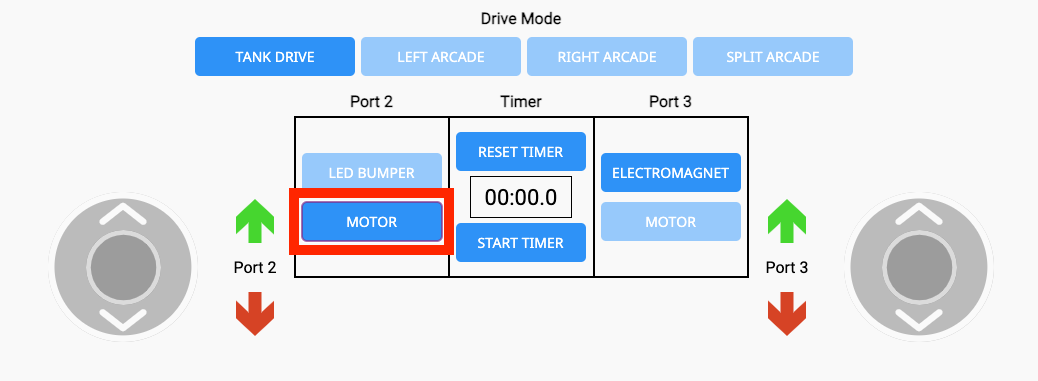
Select the Motor option for Port 2 - Model for students how to change the Drive Mode by selecting the buttons - Tank Drive, Left Arcade, Right Arcade, or Split Arcade. View the video clip below to see the movement of the joysticks as each Drive Mode is selected.
Video file- For reference, the Drive Modes correspond to the following controls:
- Tank Drive: Each joystick controls a different motor.
- Left Arcade: One joystick that controls both motors. The joystick is on the left-hand side of the screen.
- Right Arcade: One joystick that controls both motors. The joystick is on the right-hand side of the screen.
- Split Arcade: Two joysticks. One controls left and right movements and the other controls forward and reverse movements.
- Model for students how to raise and lower the arm motor using the green and red arrows around Port 2.
- Note: The arrows correspond to the direction the motor is spinning, not necessarily the up and down movements of the arm itself.
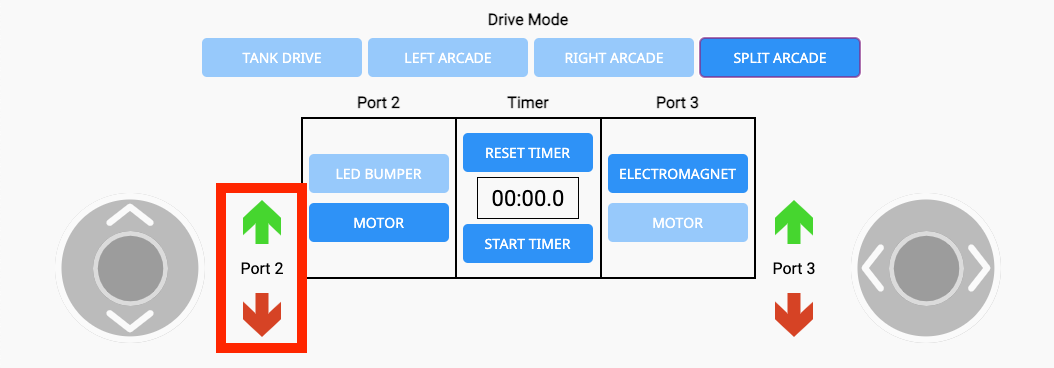
Port 2 Motor controls -
Next, set the Hero Robot on the green Tile, and model how to drive and lift and transport a house component using the Drive tab, as shown in the video in the Instruct step.
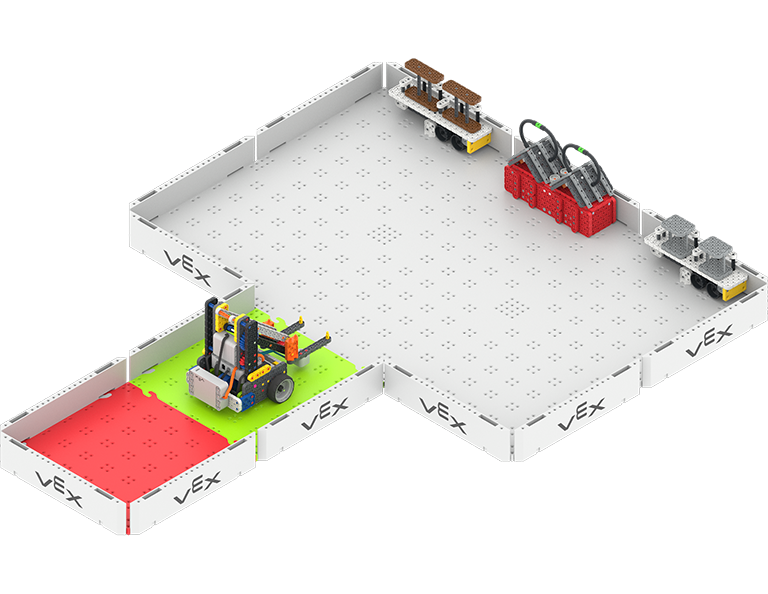
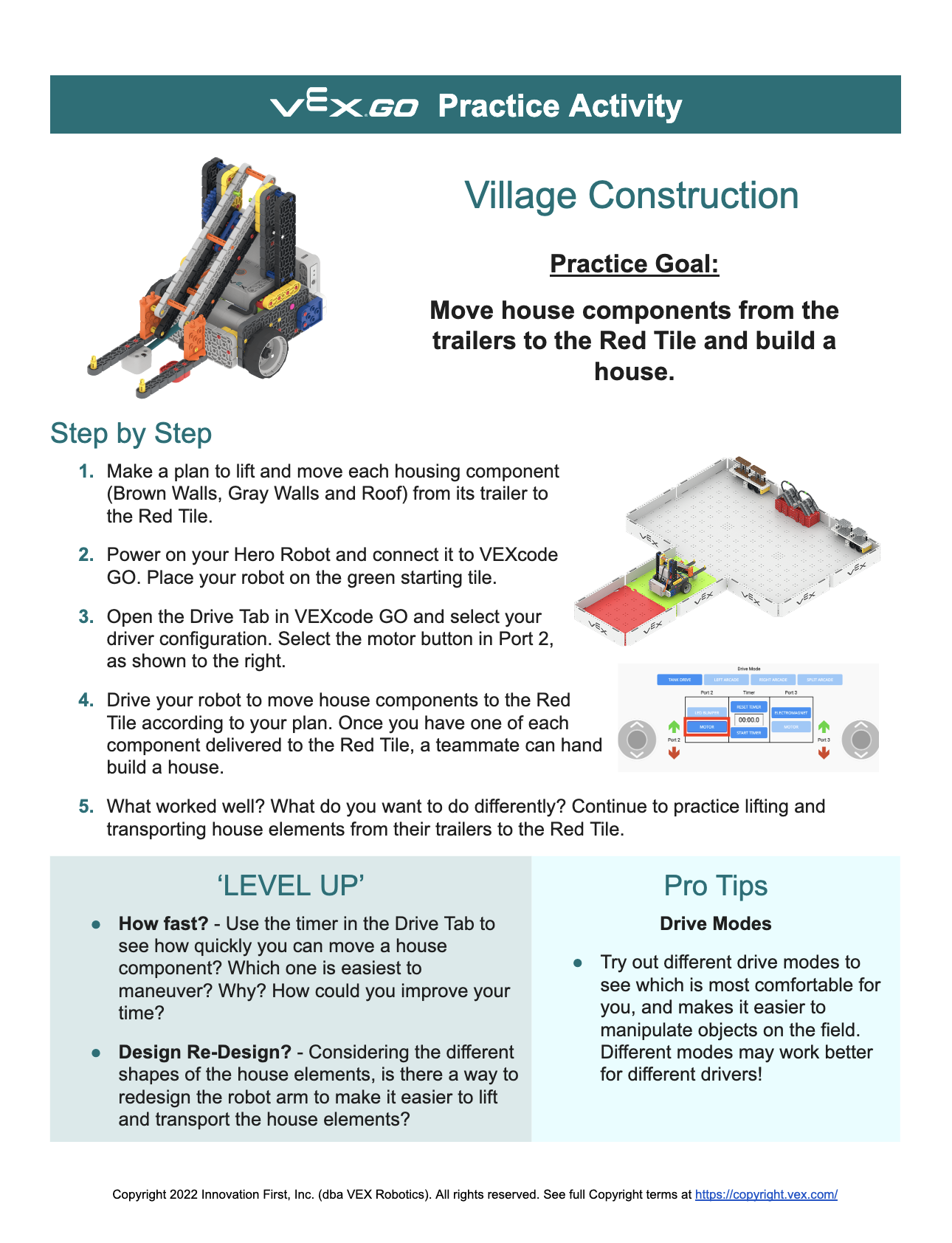
- As students are practicing driving the Hero Robot to lift and transport house components to construct a village structure on the red tile, you can use the Village Construction Practice Activity (Google Doc/.docx/.pdf) to guide them through how to practice.
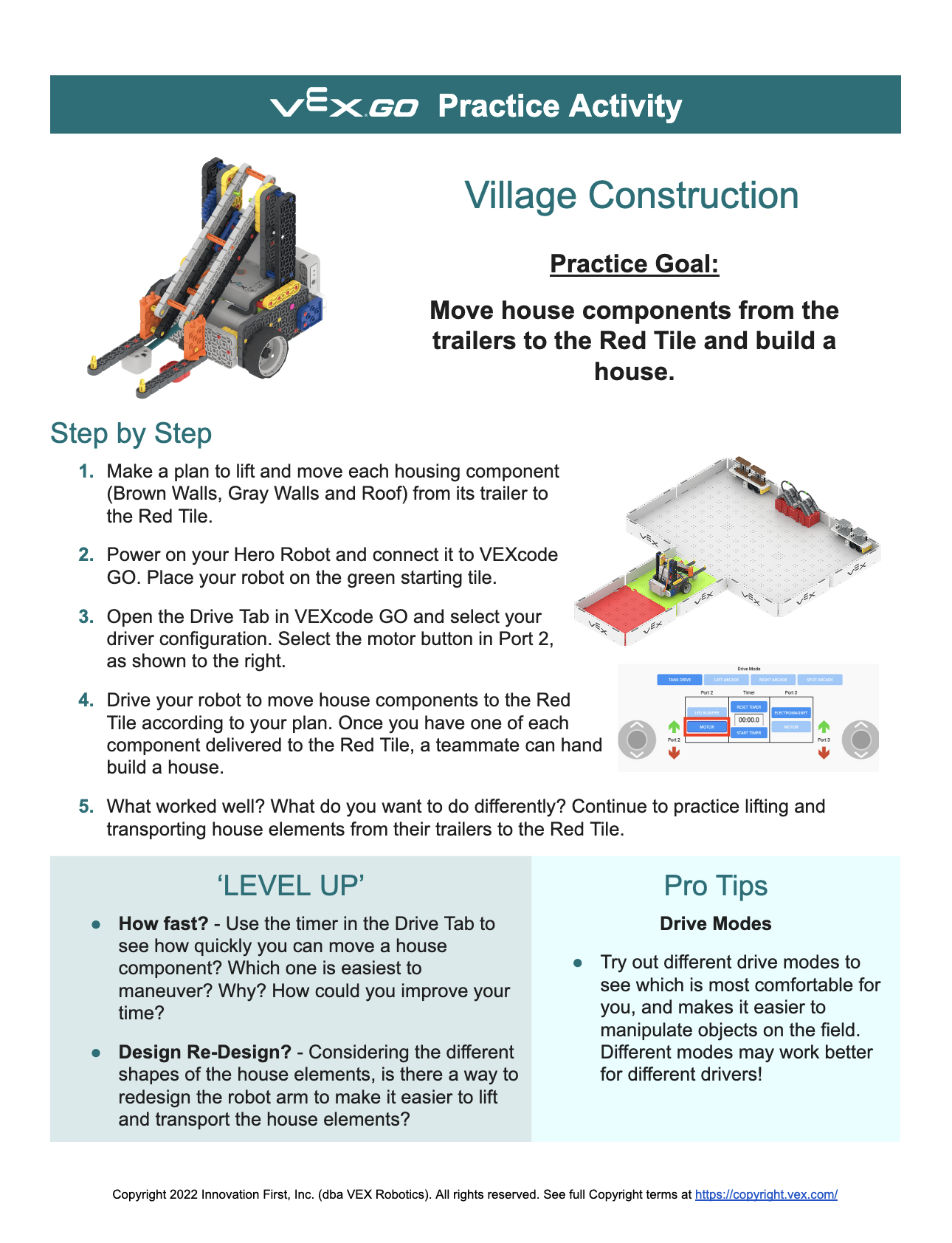
Village Construction Practice Document - If students finish the practice tasks early, and need an additional challenge, have them try one of the 'Level Up' extensions on the Village Construction Practice Activity.
- FacilitateFacilitate turn taking and collaboration between and among teams as they are practicing driving their Hero Robots. As you circulate around the room, ask questions like:
- How are you taking turns driving on your team, so everyone has a chance to practice?
- What is easier for each of you to move - the Brown Walls, Gray Walls, or Roof? Think about how the robotic arm is built and how that helps or hinders lifting the different shaped house components. What makes lifting each different house component easier or harder with the robotic arm?
- What is similar about your driving styles? What is different? What can you learn from each other to make you both better drivers?
- What is one challenge you are working together to solve? What problem solving strategies have you tried so far? What will you try next?
You may want to have multiple areas for practice set up around the room with extra Brown Walls, Gray Walls, and Roof pieces set up on pieces the same height as the trailer to practice different techniques of lift each house component. The Stage 1 Field can be broken up into individual tiles, so that you can spread out the practice areas around the classroom. You can also offer students the house components to practice moving on a flat surface, like the floor or a large table.
Facilitate conversations about drive strategy as students are practicing. You may want to allow extra time for Play Part 1, to enable all students to have enough time to get comfortable driving, so that they can begin to think about strategy. Encourage teams to look at what others are doing around the room, so that they can learn from other teams' experiences as well.
- What have they figured out through practice that has helped them be successful?
- What helps them lift and move the house components more quickly and accurately?
- How are they transporting the house components? Carrying them? Pushing them? Another method?
- RemindRemind students to try different Drive Modes to figure out which works best for them. Different Drive Modes may work better for different drivers.
Remind students that the goal of this activity is to move a Brown Wall, Gray Wall, and Roof to the Red Tile to construct a new structure. Encourage them to experiment which house component is easiest for them to move. Have them develop a strategy of moving both pieces one kind of house component at a time or to move one of each to construct a structure.
Remind students that they can choose which house components they want to move in practice, as well as in the competition. Encourage students to think about how these tasks are scored so they can use that information in developing their competition strategy.
- AskAsk students about how the actions they are doing with their Hero Robot may be connected with the actual activities that are needed in developing a community. Have them reflect and consider all the needs and of providing water, electricity and food to a community. Ask them to consider how technology aids in more cost-efficient or more environmentally friendly ways or methods that protect the life and safety of the members of the community.
Mid-Play Break & Group Discussion
As soon as every group has lifted and transported house components from the trailer to the Red Tile, and completed the human task of building new structure of Brown Walls + Gray Walls + Roof on the Red Tile, come together for a brief conversation.
Now that students have practiced driving their Hero Robots to lift and transport house components to the Red Tile to construct new structures, talk about how that practice can help them be successful in a Village Construction competition.
First, introduce the Village Construction Competition:
- The goal of the competition is to score as many points as possible by lifting and transporting house components from the trailer to the Red Tile, and the human task of constructing new structures in a one minute match.
- Each house component that is successfully removed from its trailer at the end of the match is worth one point.
- Each house component that is successfully delivered to the Red Tile at the end of the match is worth one point.
- Each completed structure on the Red Tile at the end of the match is worth one point.
Then talk about how students can apply their learning to help them be successful in competition.
- What is one thing you learned from practicing that will help you score points in the competition?
- Consider that each task is worth one point. What is a strategy that will help you score the most points in one minute?
- What is something that helped you lift the different shaped house components? Did you have a different strategy for each different component?
- How will your Hero Robot move on the Field to most efficiently transport each of the house components during the match?
Part 2 - Step by Step
- InstructInstruct students that they are now going to participate in the Village Construction Competition! The goal of the competition is to score as many points as possible by removing house components from their trailers, delivering house components to the Red Tile, and completing the human task of stacking Brown Wall + Gray Wall + Roof on the red tile to build a house on the Red Tile in a one minute match.
Use the Village Construction Competition Activity (Google Doc/.docx/.pdf) as a guide for students as you engage in the competition.
Village Construction Practice Document - ModelModel for students how they will participate in the competition matches, and how the competition will run in the classroom.
To learn more about organizing a VEX GO Classroom Competition, see this article.
-
Model how to setup the Hero Robot on the Field to begin the match with the Hero Robot starting on the green tile.

- Share with students the match order and expectations, so that they know what they should be doing during the competition before and after their turn to drive.
- You can use this Match Order template (Google Doc/.docx/.pdf) to show teams the order in which they will be competing. You can also use this sheet as a way to keep track of the score after each match. Try to have enough matches so that each student gets a chance to drive the robot at least once.

Example of match order sheet - Demonstrate for students how you will operate the timer, and what to look and listen for to know when to start and stop driving their robots on the Field.
- Show students where they can be seated during the competition matches. If you have practice areas or other spaces students can be in during the competition, show them these areas as well, and explain how they are to be used.
- Review expectations for how to be a respectful participant in the competition. Encourage students to cheer for one another, and to be excited about the competition - this is meant to be a fun classroom experience! Be sure that students are showing good sportsmanship before, during, and after each match.
- Model how a match is run. Start the timer, and drive the Hero Robot on the Field to lift the each house component off its trailer, deliver each house component to the Red Tile, and the human task of stacking Brown Wall + Gray Wall + Roof to construct a house on the Red Tile. When the timer reaches one minute, stop driving. At the end of the demonstration, count the number of house components removed from trailers, number of house components delivered to the Red Tile, and the number of houses constructed on the Red Tile, and total the score with students.
- If you are using a VEX GO Leaderboard, show students how the scores will be entered and displayed on the Leaderboard.
- Model how to reset the Field for the next Match. The house components should be replaced in their starting positions as shown in the Field Setup image above.
- Model for students how to plan a path together in their team, to begin their strategy discussions. Use this image of the Field to help facilitate the discussion, and give students a place to trace their path away from the game Field itself.

Plan a path for the robot -
- FacilitateFacilitate the classroom competition matches, and engage students in conversations about their driving and collaboration between matches. Use discussion prompts like:
- Before the start of a match:
- Which team member will be driving?
- Can you explain your strategy, or what you are going to try to do, in this match?
- Consider the various ways to earn points and decide on a strategy; such as removing all components or removing one of each to construct a house.
- What will do you try to do that is the same as practice? What is one thing you are going to try differently to improve from your practice or previous match? Why?
- During a match:
- Watch how the driver is using the arm of the robot. What do you notice? What are different strategies to remove different shaped house components from trailers/components?
- Watch how the driver is transporting the house components. What are some different ways the house components can be delivered to the Red Tile?
- How does changing the order of the tasks you are completing allow you to complete them more efficiently to earn more points?
- After a match:
- What is something you learned from your driving that you will use in your next match?
- What is something you learned from watching another driver that can help you in your match?
- Before the start of a match:
- RemindRemind students that watching the matches can help them learn things about their strategy. They may see things they want to try, or objects they want to avoid, by watching how other teams approach the competition. Just because it is not their turn to drive, does not mean they have nothing to do.
You may want to give students a way to take notes as they are watching the competition, using the Blueprint Worksheets (Google Doc/.docx/.pdf) or the Data Collection Sheet (Google Doc/.docx/.pdf). This way they can have a tangible way to keep track of strategy ideas as they prepare for their next match.
- AskAsk students to think about how their experience in this competition can help them the next time they are on a team or participating in a competition. What have they learned about being a good teammate that can be applied to the next VEX GO competition? What have they learned about being a spectator that they can use the next time they are watching a competition of any kind?