Before You Begin
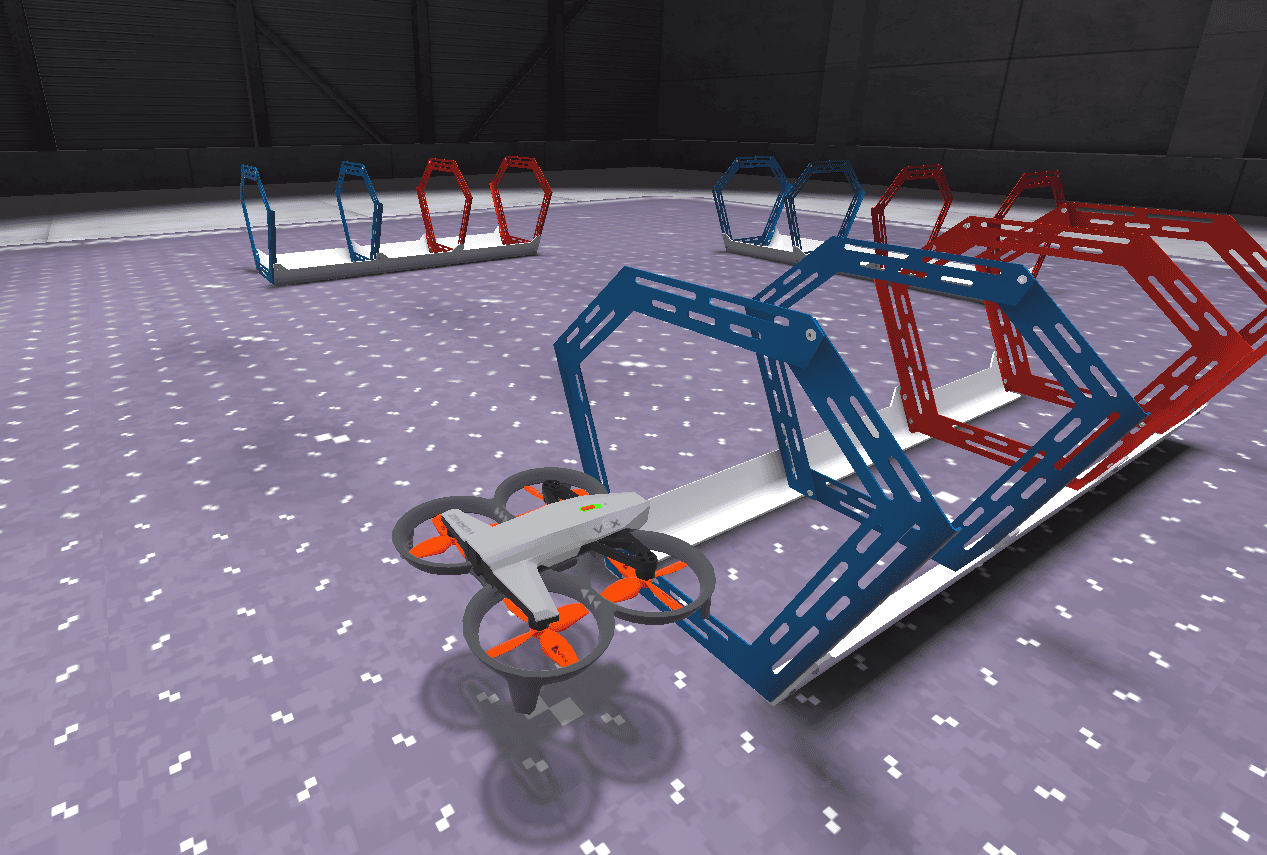
In this unit, students will apply everything they have learned to complete an open-ended challenge. Using the VEX AIR Drone Controller and VEX AIR Flight Simulator, they will fly the virtual drone through all the rings on the field as quickly as they can, with as few collisions as possible. To prepare, students will develop and refine a flight plan through practice before attempting their final challenge mission.
Be sure students have the following ready for use before you begin:
Important Safety Reminder
Although this course is focused on simulated flight rather than flying the physical drone, it is important to emphasize to students that the VEX AIR Drone is an indoor-only drone and should never be flown outdoors. Establishing this important safety rule from the beginning will help to ensure students clearly understand the expected use of the drone moving forward throughout all courses.
Learning Objectives:
- Develop a flight plan to fly through multiple rings in the VEX AIR Flight Simulator.
- Evaluate different flight strategies and identify which approaches lead to faster or more stable runs.
- Demonstrate controlled flight using multi-axis movements.
- Apply knowledge of pitch, roll, yaw, throttle, camera views, and movement modes to complete an open-ended challenge.
- Record flight attempts and reflect on how planning, movement modes, and control choices affected performance.
Preparing for the Challenge
This open-ended challenge gives students an opportunity to apply everything they have learned to complete a complex mission. Rather than following a prescribed flight path, students will create their own strategy based on what works best for them.
The goal is to fly through all the rings on the field as quickly as they can with as few collisions as possible. The challenge is divided into four phases that provide a structured approach to planning and practicing for the mission. The phases are summarized below:
- Phase 1: Develop a Flight Plan — Plan and document your flight path, including the sequence of rings and the controls needed to complete it.
- Phase 2: Practice Your Plan — Try to fly the path you documented, take notes, and get ideas for improvements.
- Phase 3: Refine your Flight Plan — Refine your flight plan based on practice data, noting pilot preferences and strategies for a successful flight.
- Phase 4: Fly the Challenge Mission — Fly based on your revised flight plan and document each flight. Continue to fly until you have your best time with zero collisions.
Standards Alignment
The following standards can be reached in this unit. To learn how these standards are met, and view a comprehensive standards alignment, go to standards.vex.com.
Common Core English Language Arts (CCSS ELA)
- CCSS.ELA-LITERACY.CCRA.L.6 - Acquire and use accurately a range of general academic and domain-specific words and phrases sufficient for reading, writing, speaking, and listening at the college and career readiness level; demonstrate independence in gathering vocabulary knowledge when encountering an unknown term important to comprehension or expression.
- CCSS.ELA-LITERACY.RST.9-10/11-12.3 - Follow precisely a complex multistep procedure when carrying out experiments, taking measurements, or performing technical tasks, attending to special cases or exceptions defined in the text.
- CCSS.ELA-LITERACY.RST.9-10/11-12.4 - Determine the meaning of symbols, key terms, and other domain-specific words and phrases as they are used in a specific scientific or technical context relevant to grade level topics.
International Society for Technology in Education (ISTE)
- Empowered Learner - 1.1.c - Students use technology to seek feedback that informs and improves their practice and to demonstrate their learning in a variety of ways.
- Empowered Learner – 1.1.d – Students understand fundamental concepts of how technology works, demonstrate the ability to choose and use current technologies effectively, and are adept at thoughtfully exploring emerging technologies.
- Knowledge Constructor – 1.3.d – Students build knowledge by exploring real-world issues and gain experience in applying their learning in authentic settings.
- Innovative Designer - 1.4.a - Students know and use a deliberate design process for generating ideas, testing theories, creating innovative artifacts or solving authentic problems.
- Innovative Designer - 1.4.d - Students exhibit a tolerance for ambiguity, perseverance and the capacity to work with open-ended problems.
- Global Collaborator - 1.7.c - Students contribute constructively to project teams, assuming various roles and responsibilities to work effectively toward a common goal.