Now it's your turn to teach your VEX AIM Coding Robot new moves! In this lesson, you'll move your robot forwards and in reverse. First by driving, then using VEXcode AIM to turn your driving path into code. You'll build on what you learned in the previous lesson to continue to explore and iterate on your project.
Watch the video below to learn about:
- Adding additional blocks to a project.
- Changing a dropdown parameter.
Now that you have watched the video, capture your thoughts in your journal. Answer these questions to guide your thinking and help you prepare for a whole-class discussion:
- How are the blocks in a project executed by the robot? Explain your thinking, even if you are unsure.
- What did you observe in the video that supports your thinking?
- List at least two questions you have about coding the robot that will help you better understand how to complete a task.
- What is something you have learned about coding or VEXcode that you think will help you be successful in this lesson?
Now that you have watched the video, capture your thoughts in your journal. Answer these questions to guide your thinking and help you prepare for a whole-class discussion:
- How are the blocks in a project executed by the robot? Explain your thinking, even if you are unsure.
- What did you observe in the video that supports your thinking?
- List at least two questions you have about coding the robot that will help you better understand how to complete a task.
- What is something you have learned about coding or VEXcode that you think will help you be successful in this lesson?
After students watch the video and before practicing, come together for a whole-class discussion. Use student answers to the questions provided as the basis for discussion.
During the discussion, model openness to different ideas, and remind students of respectful discourse habits as others are sharing. Students may have varying levels of coding experience, so what seems intuitive to some may be an important milestone for others. Help students to establish shared language around coding and using VEXcode, by reminding them to be specific in their language. Keep a list of VEXcode vocabulary visible for students to reference.
Note students' contributions on the board so students can see and build upon each other's ideas. Remind them to refer to their journals or visuals from the video to help them express their ideas with clarity.
Guided Practice
Now that you have watched and discussed the video, it is your turn to practice!
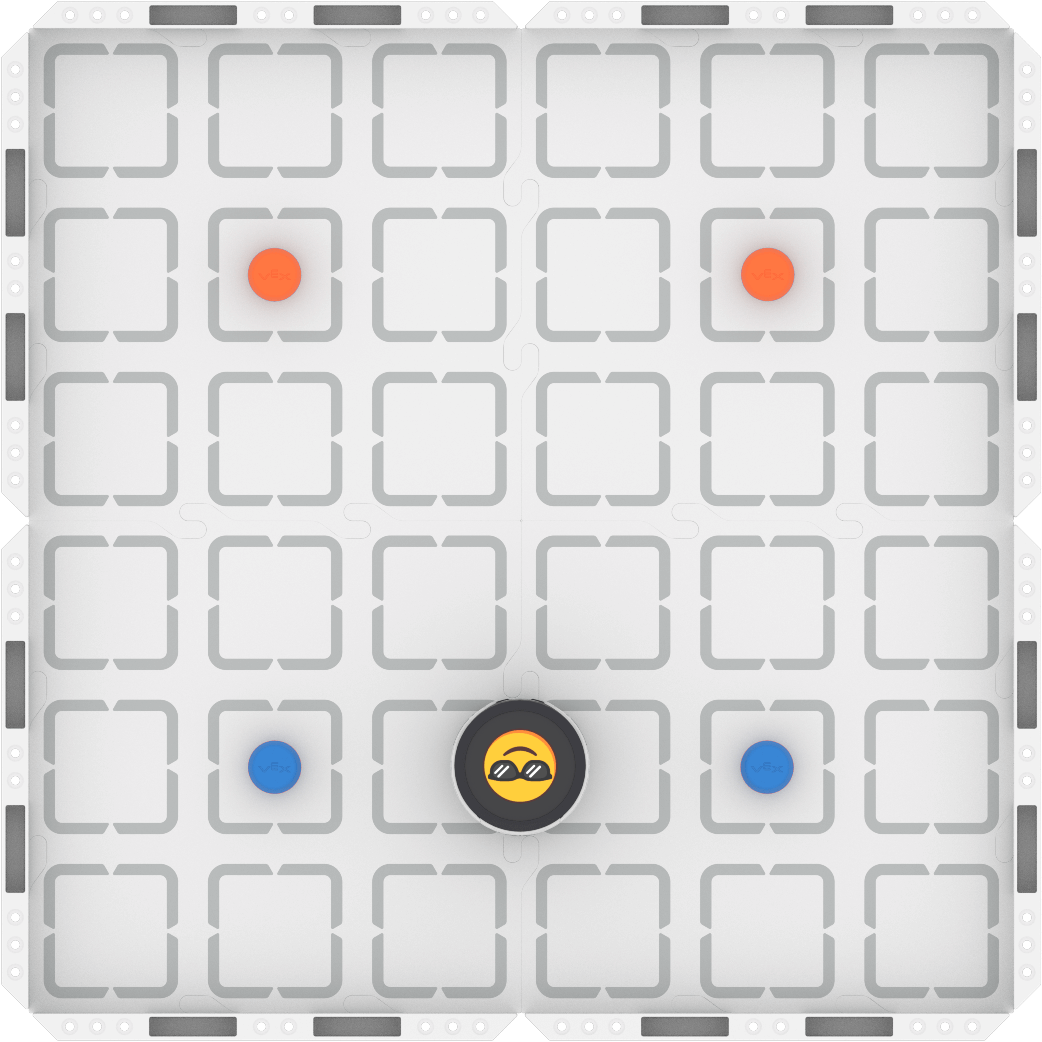
Step 1: Set up the Field as shown below.
Step 2: Model the movements of the robot needed to complete the task using Drive mode.
- Your task is to drive the robot from the blue barrels to the orange barrels and back to the starting location, passing between each set. Document your driven path, then plan how to code that movement.
- Use this task card (Google / .docx / .pdf) to guide your practice.
- Pro Tip: Consider the details you used in the previous lesson to build your coding project. Pay attention to each driven movement, and document it in detail.
Step 3: Code the robot to complete the task.
- Your task is to use your planned path from Step 2 to code the robot in VEXcode AIM to move from the blue barrels to the orange barrels, and back to the start.
- Use this task card (Google / .docx / .pdf) to guide your practice.
- Pro Tip: Return to Drive mode to help you if your group is stuck when coding. You can drive slowly if you need to, to help you identify specifics about the movement of the robot.
Step 4: Explore! Move between driving and coding to iterate on your project and improve your solution.
- Together with your group, brainstorm ways to make your project better.
- Drive the robot to test out your ideas, and choose one to start with.
- Iterate on your project to make it match the new driven behaviors.
- Continue to move between driving and coding to iterate on your project and find the best strategy to complete the task!
Resources for Practice:
The articles linked here is available if you need additional support while completing the activity.
Now that you have watched and discussed the video, it is your turn to practice!
Step 1: Set up the Field as shown below.

Step 2: Model the movements of the robot needed to complete the task using Drive mode.
- Your task is to drive the robot from the blue barrels to the orange barrels and back to the starting location, passing between each set. Document your driven path, then plan how to code that movement.
- Use this task card (Google / .docx / .pdf) to guide your practice.
- Pro Tip: Consider the details you used in the previous lesson to build your coding project. Pay attention to each driven movement, and document it in detail.
Step 3: Code the robot to complete the task.
- Your task is to use your planned path from Step 2 to code the robot in VEXcode AIM to move from the blue barrels to the orange barrels, and back to the start.
- Use this task card (Google / .docx / .pdf) to guide your practice.
- Pro Tip: Return to Drive mode to help you if your group is stuck when coding. You can drive slowly if you need to, to help you identify specifics about the movement of the robot.
Step 4: Explore! Move between driving and coding to iterate on your project and improve your solution.
- Together with your group, brainstorm ways to make your project better.
- Drive the robot to test out your ideas, and choose one to start with.
- Iterate on your project to make it match the new driven behaviors.
- Continue to move between driving and coding to iterate on your project and find the best strategy to complete the task!
Resources for Practice:
The articles linked here is available if you need additional support while completing the activity.
Foreground group work expectations at the start. To learn more about roles for collaboration in coding, view this article about pair programming. Ask questions like:
- How is your group going to get started on this activity?
- How will you make sure everyone contributes to driving, coding, and iterating?
Distribute the Step 2 task card to each student (Google / .docx / .pdf). Remember, the goal of driving the robot to complete the task is for students to develop a physical model of the task, from which they will build a computational model when they begin coding. Ensure that all students are taking the time necessary to drive, document, and plan their paths during the driven portion of Guided Practice. Establishing good habits with simple tasks will help later on as the tasks get more complex. To learn more about the value of using Drive mode with coding, see this VEX PD+ Insights Article.
As students complete their driving practice, circulate around the room and check in with students about their learning. Ask questions like:
- What is something you're paying attention to while driving that will help you code? Why is that important to you?
- Did everyone drive and document the same way? What is similar or different? How can you combine your ideas into a shared plan?
Distribute the Step 3 task card to each student after they have met the success criteria for driving, and shared their planned path with you (Google / .docx / .pdf). Students will then use their planned paths as the basis for building their initial VEXcode projects.
As students are coding the robot, circulate around the room and engage students in discussions to learn about their coding progress and understandings. Ask questions like:
- How are you making the robot move in different directions?
- What do you notice about the movement of the robot when you coded its movements versus when you drove the same path? Is the robot more precise one way or the other? Why or why not?
- How are you making sure everyone contributes to the coding process?
Once students have a working coding project, they can move on to Step 4. Remind students to add to their documentation as they explore and iterate on their projects to help them identify what strategies and details are most helpful when improving their code. Students should move between driving and coding freely and frequently during Step 4, continually working to test drive ideas for improving their projects. As students explore, ask questions like:
- Tell me about one of the ideas you tried. How did you decide if it was successful or not?
- What are you trying to improve about your project? What is your strategy for making that better?
- How are you documenting your changes? How will that documentation help you explain your project later?
Wrap-Up
Now that you have practiced, it is time to share what you learned. Answer the following questions in your journal to help you reflect on your learning and prepare for a whole-class discussion:
- What is something you learned from using driving and coding together? How did you document that learning?
- Which is more precise—driving or coding your robot? Why? What evidence do you have to support your assertion?
- What is something you learned about using VEXcode that will help you moving forward?
Now that you have practiced, it is time to share what you learned. Answer the following questions in your journal to help you reflect on your learning and prepare for a whole-class discussion:
- What is something you learned from using driving and coding together? How did you document that learning?
- Which is more precise—driving or coding your robot? Why? What evidence do you have to support your assertion?
- What is something you learned about using VEXcode that will help you moving forward?
Guide students to share their learning in a whole-class discussion. The questions students answered in their journal are the starting point for discussion. Ask follow-up questions to guide students to converge their thinking around shared understandings. Follow up with questions like:
- If someone asked you what a parameter was, what would you say? What evidence supports that?
- What do you know about driving or coding your robot now that you didn't know before practicing? What evidence do you have to support that?
- What are some tips or tricks about using VEXcode that we want to remember for future lessons? Why are they helpful?
Add to the shared list of practices for coding in VEXcode from Lesson 1 based on what students share, to help create artifacts that reflect students' shared understanding of coding their robots so far.
Select Next > to move on to the next lesson.