You've learned how to move your VEX AIM Coding Robot for different distances and directions, and how to use driving and coding together create successful projects for your robot. Now it's time to put your coding skills to the test! In this unit challenge, you'll code your robot to complete a barrel race as quickly as possible. You'll work collaboratively with your group to drive and create a strategy, build and test your code, and iterate for precision and speed to complete the challenge!
Watch the video below to review the challenge. In this unit challenge, you will code your robot to complete a barrel race! You'll need to move the robot around all four sides of each barrel on the field, and return to the starting location as quickly as possible.
Now that you have watched the video, capture your thoughts in your journal. Answer these questions to guide your thinking and help you prepare for a whole-class discussion:
- What are your initial strategy ideas for completing this challenge? List at least two ideas in your journal.
- Why do you think your strategy will be effective? Support your ideas with reasoning based on what you have learned throughout the unit.
- What questions do you have about completing this challenge? List at least two questions in your journal.
- What have you learned throughout the course so far that will help you to complete this challenge?
Now that you have watched the video, capture your thoughts in your journal. Answer these questions to guide your thinking and help you prepare for a whole-class discussion:
- What are your initial strategy ideas for completing this challenge? List at least two ideas in your journal.
- Why do you think your strategy will be effective? Support your ideas with reasoning based on what you have learned throughout the unit.
- What questions do you have about completing this challenge? List at least two questions in your journal.
- What have you learned throughout the course so far that will help you to complete this challenge?
Be sure that all students understand the goals of the challenge before beginning, and that they are formulating evidence-based strategies for completing the challenge. After students view the video, have a whole-class discussion about the challenge using students' answers to the questions as the basis.
Remind students that they can apply everything they have learned so far in the course to complete the challenge. They can use journal entries from previous units, like path planning, to support their claims or to help them form and discuss initial strategies.
Complete the Challenge
Now that you've discussed the challenge, it's time to try it!
Step 1: Set up the field as shown below.
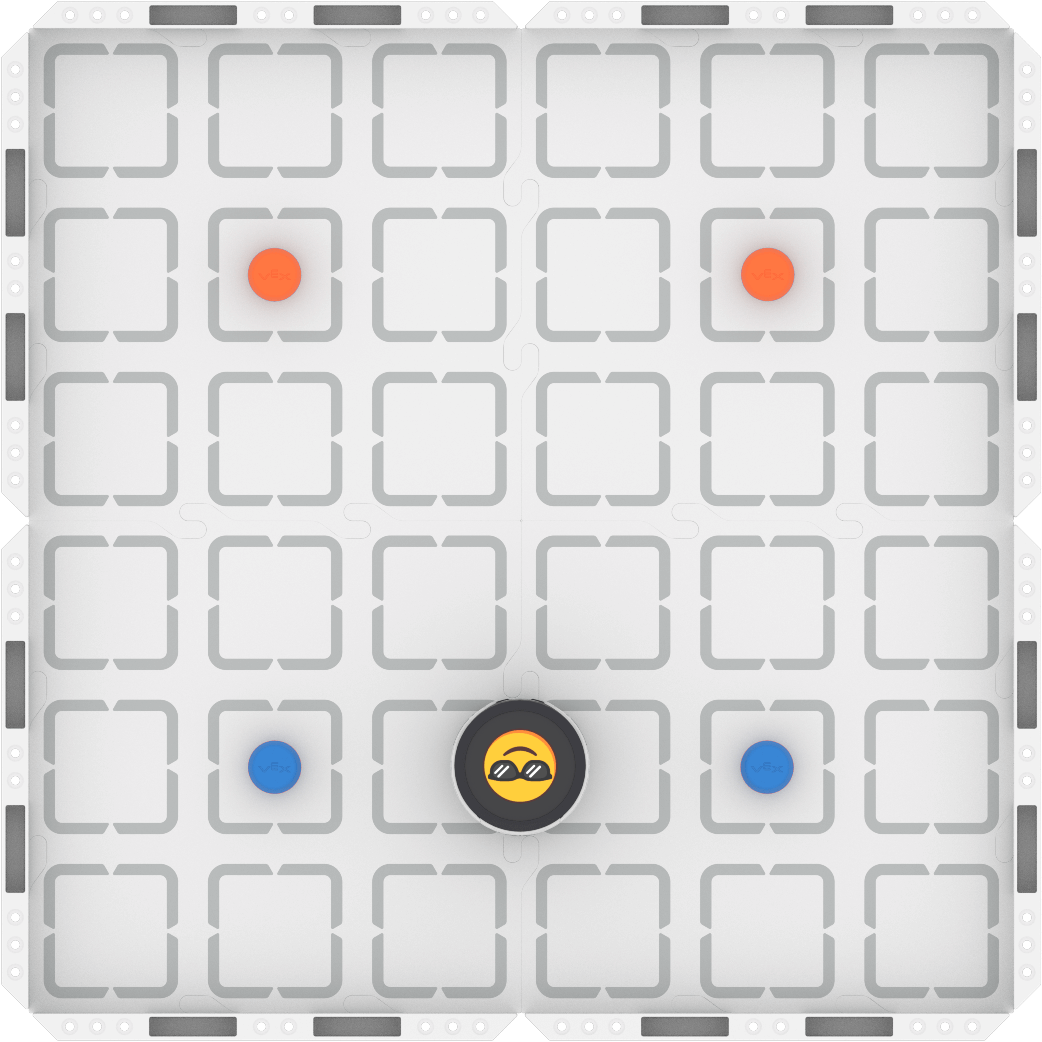
Step 2: Model the movements of the robot needed to complete the challenge using Drive mode.
- Your task is to drive the robot around all four sides of each barrel on the field and return to the starting location as quickly as possible. Document your driving strategy, then plan how you will code that movement.
- Use this task card (Google / .docx / .pdf) to guide your path planning and strategy development.
- Pro Tip: Test out several strategies before choosing one to move forward. Think about ways you can combine strategies within your group, so that you can be creative in your approach to the challenge.
Step 3: Code the robot to complete the challenge.
- Your task is to use your shared strategy and path plan from Step 2 to code the robot to move around all four sides of each barrel on the field and return to the starting location as quickly as possible.
- Use this task card (Google / .docx / .pdf) to guide your coding process.
- Pro Tip: Try numbering each of the movements in your driving strategy, to help you keep track of the sequence of behaviors. Then code one or two numbers at a time, so you build and test your project incrementally.
Step 4: Explore! Move between driving and coding to iterate on your project and improve your strategy!
- Together with your group, brainstorm ways to make your project better.
- Drive the robot to test out your ideas, and choose one to start with.
- Iterate on your project to make it match the new driven behaviors.
- Continue to move between driving and coding frequently to iterate on your project and find the best strategy to complete the challenge!
Now that you've discussed the challenge, it's time to try it!
Step 1: Set up the field as shown below.

Step 2: Model the movements of the robot needed to complete the challenge using Drive mode.
- Your task is to drive the robot around all four sides of each barrel on the field and return to the starting location as quickly as possible. Document your driving strategy, then plan how you will code that movement.
- Use this task card (Google / .docx / .pdf) to guide your path planning and strategy development.
- Pro Tip: Test out several strategies before choosing one to move forward. Think about ways you can combine strategies within your group, so that you can be creative in your approach to the challenge.
Step 3: Code the robot to complete the challenge.
- Your task is to use your shared strategy and path plan from Step 2 to code the robot to move around all four sides of each barrel on the field and return to the starting location as quickly as possible.
- Use this task card (Google / .docx / .pdf) to guide your coding process.
- Pro Tip: Try numbering each of the movements in your driving strategy, to help you keep track of the sequence of behaviors. Then code one or two numbers at a time, so you build and test your project incrementally.
Step 4: Explore! Move between driving and coding to iterate on your project and improve your strategy!
- Together with your group, brainstorm ways to make your project better.
- Drive the robot to test out your ideas, and choose one to start with.
- Iterate on your project to make it match the new driven behaviors.
- Continue to move between driving and coding frequently to iterate on your project and find the best strategy to complete the challenge!
Remind students of challenge expectations at the start.
- Students will engage in the same process of driving, coding, and exploring from the lessons to complete the unit challenge.
- Brainstorm with students how they will make sure that each group member contributes to both collaborative strategy development as well as coding and iteration.
- Remind students that iteration will be a big part of this challenge. Encourage them to document the changes they make so they can explain how they arrived at their strategy when they share it with the class later.
Distribute the Step 2 task card (Google / .docx / .pdf) to students to guide them through their collaborative strategy development. Allow extra time for driving, to ensure that all students in a group get a chance to demonstrate their path plans and strategy ideas before choosing one to move forward with.
As you circulate through the room, check in with each group to see how they are sharing and collaborating on a challenge strategy. Ask questions like:
- What have you tried so far? Was it successful? Why or why not?
- What is one thing you think you can improve on to make your collaborative strategy better than an individual one? Why do you think that will help?
- How is your group collaborating to develop a strategy or a planed path for your project?
Ensure all groups can explain their strategy to you before moving on to coding their projects in Step 3. Give a signal to the class to let them know when it is nearing time to wrap up and move on to the next step. Remind them that they can return to driving at any point to help them complete the challenge.
Distribute the Step 3 task card (Google / .docx / .pdf) to students to guide them through collaborative coding and iterating to complete the challenge.
Circulate around the room as students are coding, and engage them in conversations about their process and progress. Ask questions like:
- How many barrels have you moved around so far? What is your next step? How is your documentation helping you to effectively build and test your project?
- What challenges are you facing as you create your project? How are you solving those problems?
- How is your group collaborating to create your project together?
Students can move onto Step 4 once they have completed an initial project to complete the task. They should move freely and frequently between driving and coding to improve their projects. Encourage students to think about the reasoning behind their iterative changes as they work. Ask questions like:
- What about your strategy are you trying to improve? What is your goal for this iteration?
- Why do you think your idea will be successful? How will you know?
- How are you going to work together to implement that change? What role will each group member play in this iteration?
In a unit challenge, you can determine when it is time to end the challenge and transition students into sharing their learning. Once you feel that all groups have had time to complete the challenge effectively and iteratively, wrap up the challenge phase and move on to strategy sharing.
Share Your Strategy
Once everyone has completed the challenge, you will share your strategy with the class. To prepare for this sharing session, answer the following questions in your journal:
- Describe your final strategy for completing the challenge. Why was it successful?
- How did your group collaborate to develop that strategy together?
- How did your project change from the start of the challenge to the end? What learning from the course or unit did you use to improve your project? Be specific in your answers.
- Do you think your strategy was the best way to complete the challenge? Why or why not?
Once everyone has completed the challenge, you will share your strategy with the class. To prepare for this sharing session, answer the following questions in your journal:
- Describe your final strategy for completing the challenge. Why was it successful?
- How did your group collaborate to develop that strategy together?
- How did your project change from the start of the challenge to the end? What learning from the course or unit did you use to improve your project? Be specific in your answers.
- Do you think your strategy was the best way to complete the challenge? Why or why not?
Once everyone has completed the challenge, come together for a whole-class strategy sharing session and discussion. This is an opportunity to highlight the interplay of driving and coding to solve the challenge, and for students to engage in scientific discourse to make a claim and defend their claim with evidence. The goal of this section is to give students an opportunity to share their success, and to engage in discourse about the different strategies and approaches.
The discussion should center around the final bullet – Do you think your strategy was the best way to complete the challenge? Why or why not? By the end of the discussion, the class should have consensus on what the best approach means to them.
- Begin with one group sharing their strategy or demonstrating their project for the class, and presenting their answers to the questions.
- Other groups then respond to what was shared, using their strategy for the project and journal documentation as evidence to support their claim.
- Encourage students to think more deeply about what the ‘best’ means in this challenge. Time is an important factor, but what other criteria should be considered? Why? If two projects had the same time, what would the tiebreaker be?
Remind students about classroom expectations for respectful discourse and encourage them to agree or disagree with evidence and not judgment.
Reflect and Share
At the start of this unit, you co-created learning targets with your teacher. Once you have completed the challenge, it is time to reflect on your progress toward those learning targets.
For each of your learning targets, complete the following sentences in your journal:
- At first, I thought ___________ because ___________.
- Now that we've completed the unit challenge, I understand ___________.
- My evidence for this new understanding is ___________, which shows ___________.
Check in with your teacher when you have completed the sentences for each learning target. This reflection will help you share your learning.
At the start of this unit, you co-created learning targets with your teacher. Once you have completed the challenge, it is time to reflect on your progress toward those learning targets.
For each of your learning targets, complete the following sentences in your journal:
- At first, I thought ___________ because ___________.
- Now that we've completed the unit challenge, I understand ___________.
- My evidence for this new understanding is ___________, which shows ___________.
Check in with your teacher when you have completed the sentences for each learning target. This reflection will help you share your learning.
Remember, the purpose of Reflect and Share is to guide students to:
- Evaluate their progress toward each learning target, using evidence from their journals to support their claims.
- Guide the class as a whole to converge their thinking around the unit understandings.
- Relate their learning to real-world applications.
First, students will complete the sentences to reflect on their progress toward each of their learning targets.
Next, engage students in a whole-class discussion by inviting students to share what they wrote in their journals. Guide students towards shared conclusions about each of the unit understandings, using prompts like:
- Which explanation best matches the observations we collected throughout the unit? How do we know?
- Is there evidence that makes one explanation stronger than the others? Why?
- Can we agree on one explanation based on our combined evidence and discussions throughout the unit? Why or why not?
Once you have guided students' thinking to converge around the unit understandings, you may want to create or add to class artifacts that display the class's shared understandings for students to refer to moving forward.
Finally, students should relate their learning to the real-world connections they brainstormed at the beginning of the unit. Guide the discussion with questions like:
- What connections can you make between our learning today and the experiences you shared earlier from outside the classroom? How does what you learned apply to real-world scenarios? (Student answers will vary depending on their relevant experience.)
- How do these real-world scenarios relate to precision? What would happen if that example was not as precise?
Select Return to Units > to go back to all Units.