
Previously in this Unit, you learned how to do the following:
- Identify the movements of the 6-Axis Arm in relation to the x, y, and z-axes.
- Find the missing coordinates of a triangle using a starting location and side lengths.
- Code the 6-Axis Arm to draw shapes.
First, you coded the 6-Axis Arm to draw a triangle with known coordinates. Then, you learned how to mathematically find missing coordinates to draw a triangle and built on this to draw a square. Now, you will complete one additional activity with the 6-Axis Arm putting all of these skills together.
Putting It All Together Activity
Watch this animation to see how the 6-Axis Arm could move in order to complete the activity. In the animation below, the 6-Axis Arm moves from the safe position to coordinate (125, 50, 0). It then draws two connected right triangles to create a rhombus. The 6-Axis Arm then lifts up and moves to coordinate (175, 125, 0) where it draws four connected right triangles to create a rectangle vertically on the right hand side of the Whiteboard.
Setup: Sketch the known information about the shapes in your engineering notebook. You can use the image below for reference.
- Point A is located at (125, 50, 0)
- Point E is located at (175, 125, 0)
- Side lengths AB, AC, and EF are 50mm
- Side length EG is 75mm
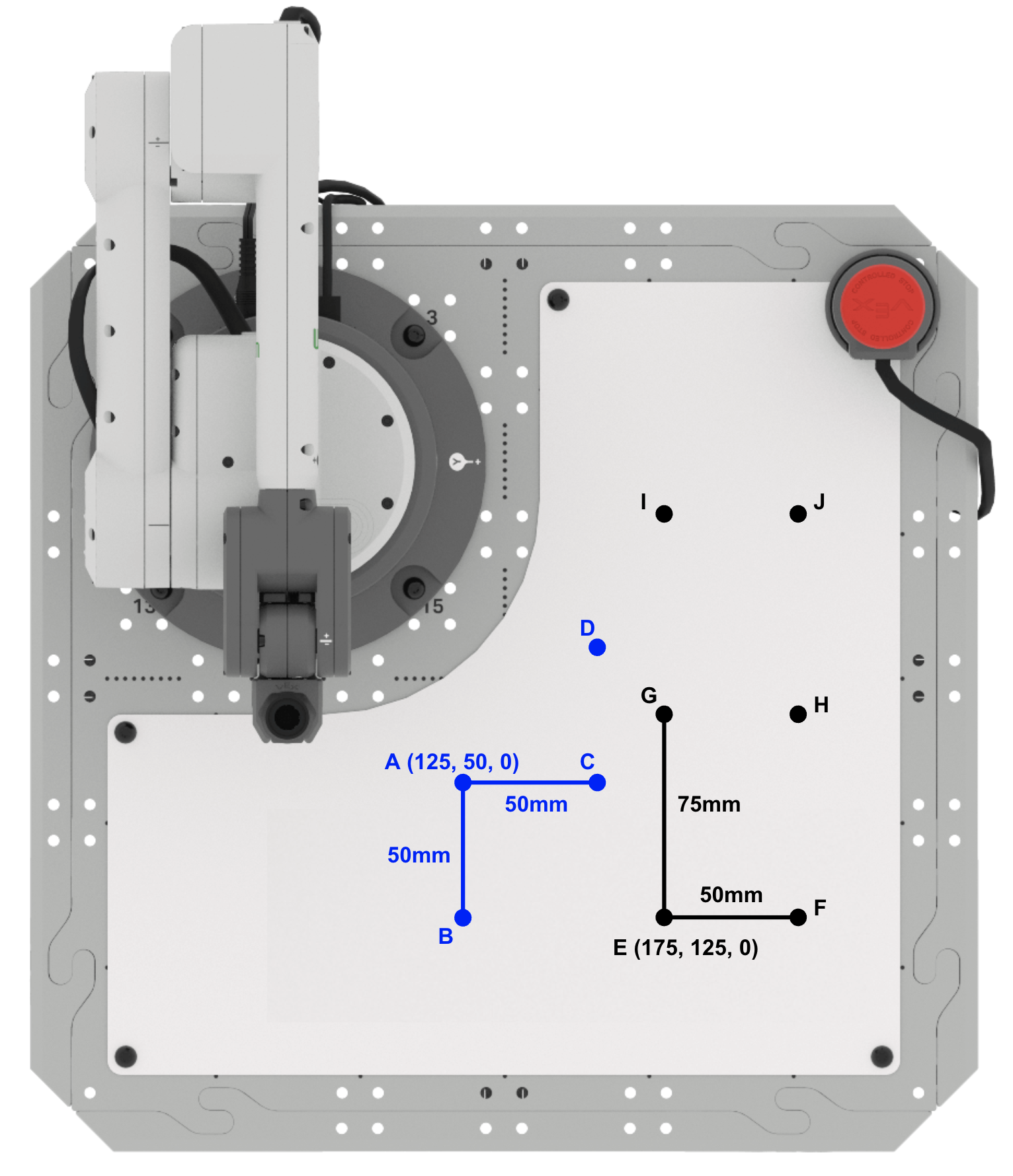
Activity: Find and use the coordinates of the unknown points to create a project for the 6-Axis Arm to draw a parallelogram and a rectangle.
- Begin by opening a New Blocks Project in VEXcode and be sure the Set end effector block is set to pen. Rename the project. You can now modify this project to complete the activity.
- Once you have edited your project, run it to test. Does the 6-Axis Arm successfully draw a parallelogram and rectangle? If not, modify your project and test it again.
- Record the process you used to find the missing points in your engineering notebook, and include details about how you used these points in your VEXcode project.
Wrap Up Reflection
Now that you have coded the 6-Axis Arm to draw a parallelogram and a rectangle, it is time to reflect on what you have learned and done in this Unit.
Rate yourself as a novice, apprentice, or expert on each of the following concepts in your engineering notebook. Provide a brief explanation for why you gave yourself that rating for each concept:
- Finding the missing coordinates of a triangle using a starting coordinate and side lengths
- Coding the 6-Axis Arm to draw shapes
- Identifying the movement of the 6-Axis Arm along multiple axes
Use this table to help you determine which category you fall under.
| Expert | I feel that I fully understood the concept and could teach this to someone else. |
| Apprentice | I feel that I understood the concept enough to complete the activity. |
| Novice | I feel that I did not understand the concept and do not know how to complete the activity. |
Then, reflect on the learning targets you co-created with your teacher for this Unit. Have you learned what you set out to learn? Why or why not? What were you most successful with? Why? How do you think you can build on your progress moving forward?
Each person in your group should complete their self-reflections in their engineering notebooks. Once everyone in your group has completed their self-reflections, check-in with your teacher and let them know you are ready for your debrief conversation.
Debrief Conversation
Using your reflections and notes in your engineering notebook, rate yourself on the Debrief Conversation Rubric linked here (Google Doc / .docx / .pdf). For each of the topics, rate yourself as Expert, Apprentice, or Novice.
Ask your instructor if you need any clarification on what is expected of you during this self-assessment.

Select < Return to Units to go back to all Units.